
Quick Answer
Sodium hypochlorite procurement is not simply a matter of finding the lowest price per litre or tonne. Industrial buyers should evaluate available chlorine concentration, product stability, impurity levels, packaging, shelf life, documentation, minimum order quantity, delivery requirements and supplier reliability before placing an order.
For continuous water treatment, wastewater treatment, industrial sanitation and bleaching applications, buyers commonly compare sodium hypochlorite solutions in the 10–15% available chlorine range, depending on the process and application. Moon Bright Resources supplies sodium hypochlorite primarily in 10% and 15% grades, with packaging options ranging from 20 L containers through IBCs and bulk tanker supply. moonbrightresources.com
Why Sodium Hypochlorite Procurement Requires More Than a Price Comparison
Sodium hypochlorite is a liquid chemical whose available chlorine gradually decreases during storage. This means that two products with the same nominal concentration at the time of quotation may not provide identical value when delivered, stored and eventually dosed into a treatment system.
A proper procurement comparison should therefore consider:
- Available chlorine concentration
- Strength retention and product age
- Free alkali content
- Iron and other impurities
- Specific gravity
- Packaging compatibility
- Storage and handling requirements
- Certificate of Analysis availability
- Safety Data Sheet availability
- Delivery lead time
- Minimum order quantity
- Bulk supply capability
- Supplier experience with international logistics
For buyers purchasing repeatedly, delivered cost per unit of usable available chlorine can be more meaningful than the quoted price per container.
What Specification Should Buyers Request?
Before requesting quotations, procurement teams should prepare a clear technical specification.
A typical sodium hypochlorite purchase specification may include:
| Specification | Example Requirement |
|---|---|
| Chemical | Sodium Hypochlorite |
| CAS Number | 7681-52-9 |
| Available Chlorine | 10% or 15%, according to application |
| Appearance | Clear to pale yellow/green liquid |
| pH | Alkaline |
| Free Alkali | Specified maximum/minimum range |
| Iron | Controlled impurity level |
| Packaging | HDPE container, drum, IBC or tanker |
| Documentation | COA and SDS |
| Delivery | Agreed Incoterm and destination |
The exact specification should be established according to the buyer’s application, local regulations and technical requirements rather than copied from a generic supplier listing.
10% vs 15% Sodium Hypochlorite
Concentration is one of the most important procurement decisions.
Moon Bright Resources lists both 10% and 15% available chlorine grades. Its product information indicates that higher-concentration sodium hypochlorite generally has a faster degradation rate, making storage conditions and stock rotation increasingly important as concentration increases. Mmoonbrightresources.com
10% Sodium Hypochlorite
A 10% grade can be suitable for applications including:
- Municipal water treatment
- Wastewater treatment
- Industrial sanitation
- Commercial laundry
- Routine disinfection
15% Sodium Hypochlorite
A 15% grade may be selected where a higher concentration is commercially or operationally advantageous, including certain industrial disinfection and bleaching applications.
However, concentration should not be selected independently of the dosing system, storage conditions, transport distance and expected consumption rate.
Packaging and Delivery
Packaging becomes increasingly important as purchasing volume increases.
Moon Bright Resources lists several sodium hypochlorite packaging formats, including:
- 20 L HDPE jerry cans
- 30 L carboys
- 200 L drums
- 1,000 L IBC totes
- Bulk tanker deliveries of approximately 10–25 metric tons
Custom OEM packaging is also offered for larger commercial requirements. Mmoonbrightresources.com
For smaller buyers, drums or jerry cans may offer flexibility. For regular industrial consumption, IBCs can reduce handling frequency. High-volume users may benefit from bulk tanker deliveries when appropriate storage infrastructure is available.
How to Compare Sodium Hypochlorite Suppliers
A procurement department should assess a supplier against several criteria rather than using price alone.
1. Product consistency
Ask whether each shipment is supplied against a defined specification and whether batch-specific quality documentation is available.
2. Available chlorine
Confirm the concentration being quoted and whether the figure represents the specification at production, dispatch or another defined point.
3. Documentation
Commercial chemical purchases should be supported by appropriate technical and safety documentation. Moon Bright Resources identifies Certificates of Analysis and Safety Data Sheets among the documentation available for its chemical supply operations. Mmoonbrightresources.com
4. Packaging
Confirm container material, capacity, compatibility and whether the packaging is appropriate for the chemical and intended transport route.
5. Shelf-life management
Sodium hypochlorite loses strength over time. Buyers should therefore establish production dates, recommended storage conditions, expected shelf life and stock-rotation procedures before purchasing large quantities.
6. Logistics capability
For international procurement, evaluate:
- Origin
- Destination
- Incoterms
- Transport method
- Lead time
- Shipment frequency
- Packaging configuration
- Dangerous-goods requirements
- Import documentation
What Should Be Included in a Sodium Hypochlorite RFQ?
A well-prepared Request for Quotation can significantly improve supplier comparisons.
Your RFQ should state:
Product: Sodium Hypochlorite
Required concentration: 10% / 15% available chlorine
Quantity: Required volume per shipment
Annual requirement: Estimated yearly consumption
Packaging: Drum / IBC / tanker
Destination: Delivery location
Required documents: COA / SDS / technical documentation
Delivery schedule: Required first shipment and recurring frequency
Commercial terms: Requested Incoterm and payment terms
This gives suppliers enough information to provide a meaningful quotation instead of a generic price.
Bulk Sodium Hypochlorite Procurement
For recurring industrial requirements, procurement teams should consider a supply agreement rather than treating every shipment as an isolated purchase.
A longer-term arrangement can potentially improve:
- Supply continuity
- Forecasting
- Production planning
- Packaging availability
- Delivery scheduling
- Commercial consistency
However, the contract should also define quality specifications, acceptance criteria, documentation, delivery tolerances and procedures for handling off-specification material.
Sodium Hypochlorite Storage Must Be Considered Before Ordering
Large-volume procurement should never be separated from storage planning.
Sodium hypochlorite should generally be stored in compatible containers in a cool, shaded and well-ventilated environment, away from incompatible substances. Moon Bright Resources specifically advises protection from heat and sunlight and separation from acids, ammonia, organic materials, reducing agents and incompatible metals. Mmoonbrightresources.com
Because higher temperatures accelerate degradation, purchasing more product than can be consumed within an appropriate period may not necessarily produce better economics.
Procurement quantity should therefore be based on consumption rate, storage capacity, delivery frequency and product stability—not simply the largest available discount.
Sodium Hypochlorite Procurement Checklist
Before approving a supplier, procurement teams should confirm:
- Required available chlorine concentration
- Technical specification
- Batch/lot identification
- Certificate of Analysis
- Safety Data Sheet
- Packaging type and size
- Production or dispatch date
- Storage requirements
- Expected shelf life
- MOQ
- Lead time
- Delivery terms
- International shipping capability, where applicable
- Quality claim and rejection procedure
- Technical support
Choosing a Sodium Hypochlorite Supplier
The right supplier should provide more than a competitive chemical price.
For industrial buyers, the stronger procurement decision is usually the supplier capable of combining consistent product specifications, appropriate packaging, reliable documentation, predictable logistics and responsive commercial support.
Moon Bright Resources supplies sodium hypochlorite in multiple concentrations and packaging formats, including 10% and 15% available chlorine grades, IBCs and bulk tanker options for larger requirements. Mmoonbrightresources.com
Frequently Asked Questions
What is the MOQ for sodium hypochlorite?
Moon Bright Resources lists 20 L for sample orders, 200 L for small commercial orders and 10 metric tons for wholesale pricing. Bulk tanker deliveries are available for larger recurring requirements. Mmoonbrightresources.com
Can sodium hypochlorite be supplied in IBCs?
Yes. Moon Bright Resources lists 1,000 L IBC totes as a packaging option. Mmoonbrightresources.com
Can buyers request OEM or private-label packaging?
Yes. Moon Bright Resources states that OEM and private-label sodium hypochlorite packaging is available, with a stated minimum OEM quantity of 10 metric tons. Mmoonbrightresources.com
What documents should be requested when purchasing sodium hypochlorite?
At minimum, buyers should establish the required technical and safety documentation for their application and destination. Moon Bright Resources identifies Certificates of Analysis and Safety Data Sheets as part of its chemical supply documentation. moonbrightresources.com
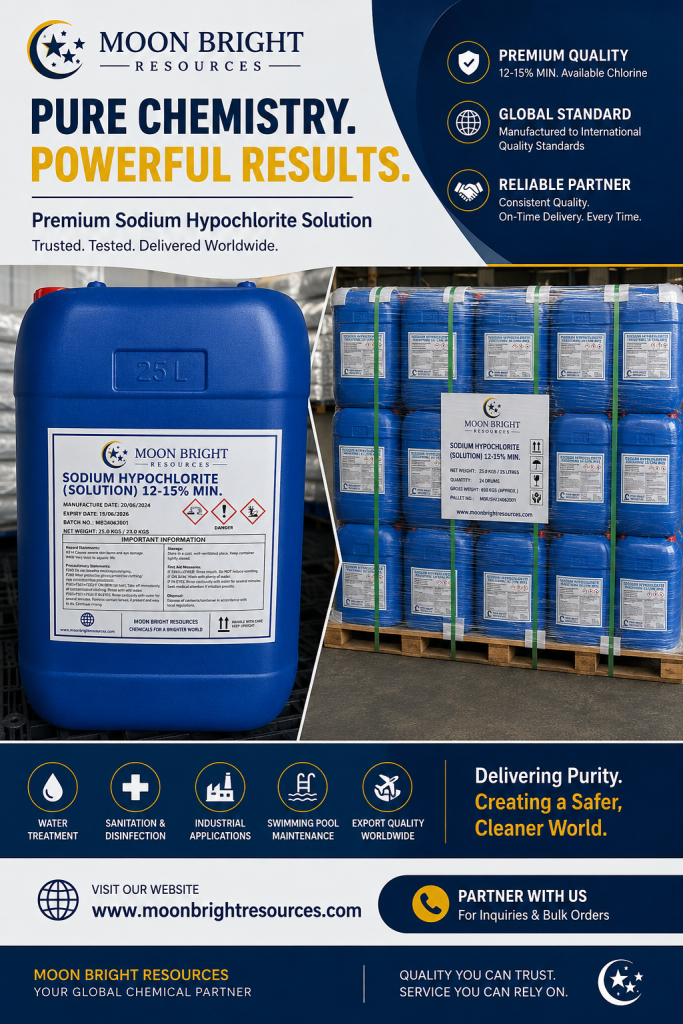
Request a Sodium Hypochlorite Bulk Quotation
If you are sourcing sodium hypochlorite for water treatment, wastewater treatment, industrial sanitation, bleaching or another commercial application, provide your required concentration, quantity, packaging preference and destination to obtain a quotation.
For current product specifications, packaging options and bulk purchasing enquiries, visit the Moon Bright Resources sodium hypochlorite product page.
Sodium Hypochlorite – Moon Bright Resources
Article 5 — Quality / Compliance
Sodium Hypochlorite Quality and Compliance Guide: Specifications, Testing, Documentation and Supplier Verification
Quick Answer
Sodium hypochlorite quality should be evaluated through a combination of available chlorine concentration, chemical stability, impurity control, physical characteristics, batch documentation, packaging suitability and applicable regulatory requirements.
For industrial and water-treatment buyers, a supplier’s ability to provide consistent specifications and appropriate documentation can be just as important as the initial purchase price. Moon Bright Resources lists 10% and 15% available chlorine sodium hypochlorite grades and identifies parameters including available chlorine, free alkali, iron content, specific gravity, pH and strength retention. moonbrightresources.com
What Determines Sodium Hypochlorite Quality?
Sodium hypochlorite is not judged by concentration alone.
A quality assessment can include:
- Available chlorine
- Free alkali
- Iron and other impurities
- Specific gravity
- pH
- Appearance
- Product stability
- Strength retention
- Packaging integrity
- Batch traceability
These parameters help buyers determine whether the material is appropriate for the intended application and whether the delivered product conforms to the agreed specification.
Available Chlorine: The Primary Quality Parameter
Available chlorine is one of the most important characteristics of sodium hypochlorite.
Moon Bright Resources lists:
- 10% grade: 10% ± 0.5% available chlorine
- 15% grade: 15% ± 0.5% available chlorine
The product page also lists strength-retention targets under defined conditions, illustrating why both initial concentration and subsequent stability matter when evaluating sodium hypochlorite. moonbrightresources.com
A buyer should always compare test results against the agreed product specification and applicable standard, rather than assuming that a nominal concentration automatically represents the same performance across every supplier.
Sodium Hypochlorite Impurities
Impurities can influence product stability, equipment compatibility and application performance.
Moon Bright Resources specifies controlled iron content for its listed grades, with a stated iron specification of ≤5 ppm. It also provides a free-alkali range and specific-gravity specifications for its 10% and 15% grades. moonbrightresources.com
For applications involving sensitive equipment, drinking-water treatment or tightly controlled industrial processes, buyers should determine which impurity parameters are relevant to their operation before finalising a specification.
Why Sodium Hypochlorite Stability Matters
Sodium hypochlorite gradually decomposes, meaning product quality can change between manufacture and use.
Degradation is affected by factors such as:
- Temperature
- Light exposure
- Concentration
- Storage duration
- Contamination
- Container conditions
Moon Bright Resources identifies faster degradation at higher concentrations and recommends cool, dark storage. moonbrightresources.com
This is particularly important for procurement teams buying large quantities. A product that meets specification when manufactured still needs appropriate storage and stock rotation to retain its required strength.
How Is Sodium Hypochlorite Strength Tested?
For precise determination of available chlorine, iodometric titration using a thiosulfate method is a standard analytical approach.
For operational checks, field test methods can provide faster measurements, although their suitability depends on the required accuracy and application.
Moon Bright Resources recommends iodometric titration for accurate measurement and notes that portable testing methods can be used for approximate field measurements. moonbrightresources.com
For critical dosing operations, buyers should establish a documented testing procedure appropriate to their facility and applicable technical requirements.
Certificate of Analysis: What Should Buyers Check?
A Certificate of Analysis, or COA, is an important part of batch-level quality verification.
When reviewing a COA, buyers should check:
- Product name
- Batch or lot number
- Manufacturing or test date
- Available chlorine result
- Relevant chemical parameters
- Test methods, where provided
- Specification limits
- Actual test results
- Approval or authorised sign-off
The COA should correspond to the actual batch being supplied.
A generic specification sheet is useful for understanding a product, but it does not replace batch-specific quality evidence where the purchasing specification requires it.
Safety Data Sheet and Chemical Compliance
The Safety Data Sheet, or SDS, provides essential information for the safe handling, storage, transport and emergency management of the chemical.
Before purchasing sodium hypochlorite, buyers should ensure that the SDS is appropriate for the product and destination market and that their organisation’s personnel can access the current version.
The SDS should be reviewed alongside site-specific risk assessments, storage procedures and applicable local requirements.
Standards and Certifications
Different sodium hypochlorite applications may require different standards or regulatory approvals.
Moon Bright Resources lists NSF/ANSI 60 and AWWA B300 among the standards associated with its sodium hypochlorite product information, with the stated applicability differing by grade. moonbrightresources.com
Importantly, buyers should not assume that a supplier’s statement that a product “meets a standard” automatically satisfies every legal or project-specific requirement.
The purchaser should verify:
- Which grade is covered
- Which concentration is covered
- Whether certification is current
- Whether the certification applies to the intended use
- Whether the destination country imposes additional requirements
- Whether the project owner specifies additional documentation
Quality Control Before Shipment
For larger commercial purchases, a robust quality process can include:
Stage 1: Supplier qualification
Evaluate the supplier’s product specifications, documentation, manufacturing or sourcing capability and logistics experience.
Stage 2: Specification agreement
Define the exact chemical and quality requirements before placing the purchase order.
Stage 3: Batch documentation
Require the appropriate COA and SDS documentation.
Stage 4: Delivery inspection
Check packaging integrity, labels, batch identification and shipment documentation when the material arrives.
Stage 5: Verification testing
Where required, test available chlorine or other critical parameters according to the agreed quality-control procedure.
Stage 6: Traceability
Maintain batch numbers and documentation so the material can be traced through storage and application.
Storage Is Part of Quality Control
Quality control does not end when the chemical reaches the warehouse.
Sodium hypochlorite should be stored under appropriate conditions to reduce degradation and protect personnel and equipment.
Moon Bright Resources recommends compatible plastic containers and cool, dark, well-ventilated storage, with separation from incompatible substances such as acids and ammonia. moonbrightresources.com
The storage area should also be designed around the requirements of the applicable SDS, local regulations and site risk assessment.
Sodium Hypochlorite Quality Verification Checklist
Before accepting a shipment, buyers can verify:
- Product identity
- Grade and concentration
- Batch number
- COA
- SDS
- Available chlorine
- Appearance
- Packaging integrity
- Container compatibility
- Manufacturing or dispatch date
- Storage conditions
- Labelling
- Transport documentation
- Applicable certification or compliance documentation
Supplier Qualification: Questions to Ask
Before selecting a sodium hypochlorite supplier, quality and procurement teams should ask:
Can you provide a batch-specific COA?
What available chlorine concentration do you guarantee?
How is available chlorine tested?
What impurity limits are controlled?
What packaging materials are used?
How is product stability managed during storage and transport?
What SDS is supplied with each shipment?
Which standards or certifications apply to the supplied grade?
Can you support recurring bulk deliveries?
Can you provide technical documentation for our destination market?
These questions turn supplier selection from a simple price exercise into a structured quality and risk assessment.
Why Quality Documentation Matters
For industrial buyers, quality documentation provides more than paperwork.
It helps establish:
- Product identity
- Batch traceability
- Specification compliance
- Safe handling requirements
- Regulatory review
- Internal quality assurance
- Supplier accountability
This becomes particularly important when sodium hypochlorite is used in water treatment, wastewater treatment, food-processing sanitation or other applications where chemical quality can affect the wider process.
Choosing a Quality-Focused Sodium Hypochlorite Supplier
A reliable sodium hypochlorite supplier should be able to demonstrate consistency not only through product specifications but also through documentation, traceability, packaging, technical support and dependable supply.
Moon Bright Resources describes its sodium hypochlorite as available primarily in 10% and 15% available chlorine grades and provides technical parameters covering concentration, free alkali, iron, specific gravity, pH and strength retention. The company also identifies COA and SDS documentation as part of its broader chemical supply offering. moonbrightresources.com+1
Frequently Asked Questions
What is the CAS number for sodium hypochlorite?
The CAS number listed by Moon Bright Resources for sodium hypochlorite is 7681-52-9. moonbrightresources.com
What available chlorine concentrations are available?
Moon Bright Resources lists sodium hypochlorite in concentrations from 5% to 15%, with its primary listed commercial grades being 10% and 15%. moonbrightresources.com
How should sodium hypochlorite quality be tested?
Iodometric titration is an appropriate analytical approach for determining available chlorine, while suitable field test methods can be used for operational checks. The appropriate method should be determined according to the required accuracy and application. moonbrightresources.com
Does sodium hypochlorite have a fixed shelf life?
Its stability depends on concentration and storage conditions. Higher concentrations generally degrade more rapidly, while heat, light and unsuitable storage conditions can accelerate degradation.Sodium hypochlorite procurement
What documentation should accompany an industrial sodium hypochlorite purchase?
The exact documentation depends on the application and destination, but buyers commonly require a Certificate of Analysis, Safety Data Sheet, technical specification and any applicable certification or compliance documentation.
Request Sodium Hypochlorite Specifications and Documentation
If your organisation is evaluating sodium hypochlorite suppliers, request the current product specification, applicable certifications, batch documentation, SDS and commercial quotation before making a purchasing decision.
For Moon Bright Resources’ current sodium hypochlorite grades, packaging options and technical information:
View the Sodium Hypochlorite Product Page

 English
  French
  Arabic
  Spanish
  Bulgarian