
Quick Answer: How Do You Choose a Sodium Hypochlorite Supplier?
The best sodium hypochlorite supplier should provide the required concentration, consistent batch quality, appropriate packaging, Certificate of Analysis (COA), Safety Data Sheet (SDS), reliable delivery and transparent commercial terms. Buyers should compare suppliers based on product specification and total delivered cost, rather than selecting a supplier solely because of the lowest quoted price.
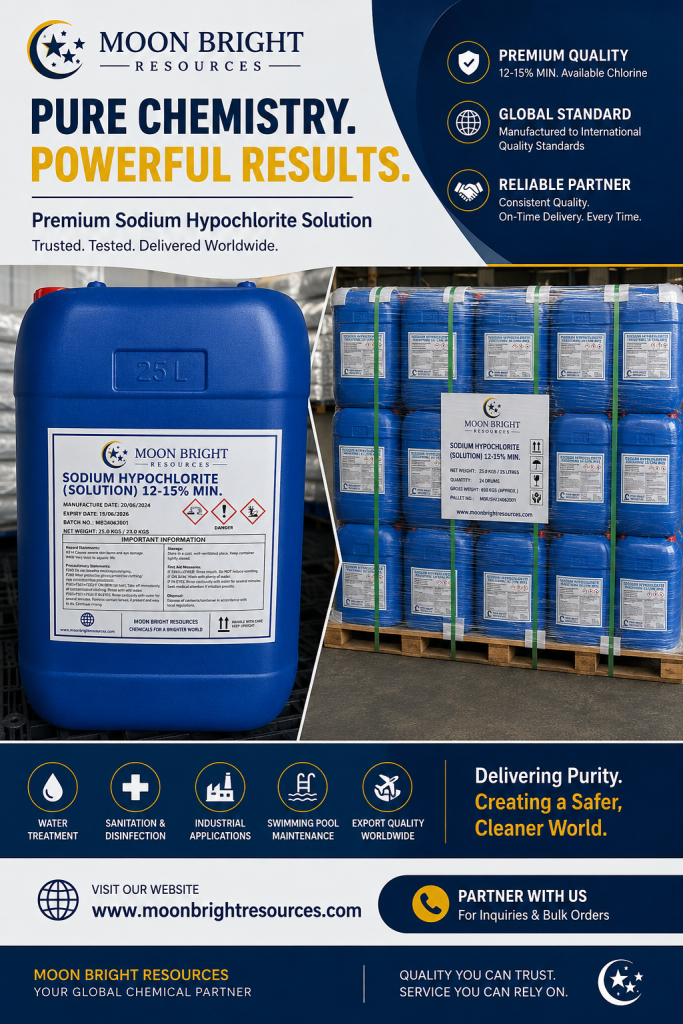
Moon Bright Resources supplies sodium hypochlorite in multiple strengths, including 10% and 15% available-chlorine grades, with commercial packaging options for water treatment, industrial effluent treatment, sanitation, food processing, laundry and other applications. moonbrightresources.com
For product specifications and available supply options, see the Moon Bright Resources Sodium Hypochlorite product page.
What Is a Sodium Hypochlorite Supplier?
A sodium hypochlorite supplier provides sodium hypochlorite solution to commercial, industrial, institutional or other customers according to an agreed concentration, grade, packaging and delivery specification.
A supplier may operate as:
- A chemical manufacturer
- An authorized distributor
- An exporter
- A wholesale chemical supplier
- A regional distributor
- A water-treatment chemical supplier
- A specialty chemical distributor
- A sourcing and procurement company
The distinction matters because the buyer’s requirements may be different depending on whether they need a one-time shipment, recurring industrial supply or a large-volume contract.
For example, a water-treatment operator may require a documented concentration and batch COA for every delivery, while a manufacturer may place greater emphasis on consistent concentration, impurity limits, packaging and delivery scheduling.
Why Choosing the Right Sodium Hypochlorite Supplier Matters
Sodium hypochlorite is not simply a commodity where every quotation can be compared by price alone.
Two suppliers can advertise “10% sodium hypochlorite” while differing in:
- Available chlorine specification
- Sodium hydroxide content
- Impurity limits
- Manufacturing process
- Batch consistency
- Packaging
- Manufacturing date
- Storage conditions
- Documentation
- Delivery terms
Commercial specifications can be quite detailed. For example, a recent municipal procurement specification requires information including sodium hypochlorite concentration, available chlorine, density, sodium hydroxide concentration, pH and batch/manufacturer information on the COA. ewa.org
This is why supplier qualification should happen before price comparison.
What Should You Look for in a Sodium Hypochlorite Supplier?
A reliable supplier should be able to answer five fundamental questions:
- What exactly is being supplied?
- Can the supplier prove the product meets the specification?
- Can the supplier consistently supply the required quantity?
- Can the supplier package and transport it appropriately?
- Can the supplier provide the required documentation?
If a supplier cannot clearly answer these questions, the buyer should investigate further before placing a commercial order.
1. Verify the Sodium Hypochlorite Concentration
Concentration is one of the first specifications that should be confirmed.
Moon Bright Resources currently lists:
- 10% available chlorine ± 0.5%
- 15% available chlorine ± 0.5%
along with other technical parameters including appearance, CAS number, molecular formula, molecular weight, free alkali and iron content. moonbrightresources.com
However, buyers should not assume that a supplier’s stated percentage means the same thing in every quotation.
Ask whether the stated concentration represents:
- Available chlorine
- Sodium hypochlorite concentration
- Weight/weight percentage
- Weight/volume percentage
- Assay
- Trade percentage
These terms should be clarified before comparing quotations.
2. Ask for a Batch-Specific COA
A Certificate of Analysis (COA) is one of the most important documents when purchasing industrial sodium hypochlorite.
A good COA should identify the batch or lot and provide relevant test results against the agreed specification.
Depending on the application, the COA may include:
- Sodium hypochlorite concentration
- Available chlorine
- Sodium hydroxide/free alkali
- pH
- Density
- Iron
- Heavy metals or other impurities
- Test methods
- Batch number
- Manufacturing date
- Manufacturer information
A recent municipal sodium hypochlorite specification illustrates how detailed a procurement COA can be, requiring concentration, available chlorine, density, sodium hydroxide concentration, pH and manufacturing information. ecwa.org
Some commercial suppliers also provide lot-specific COAs with shipments. Alliance Chemical
Why a COA matters
A supplier’s product page tells you what the supplier says it sells.
A batch-specific COA helps demonstrate what was tested for the particular shipment.
For recurring procurement, buyers should consider making batch documentation part of the purchase specification.
3. Request the SDS Before Ordering
The Safety Data Sheet (SDS) provides essential information about hazards, handling, storage, transport, personal protective equipment and emergency response.
This is particularly important for sodium hypochlorite because concentrated solutions can be corrosive and require appropriate handling.
For example, a commercial 14% sodium hypochlorite specification identifies severe skin and eye hazards and notes that contact with acids can liberate toxic gas. GGlentham Life Sciences
Before purchasing sodium hypochlorite, ask the supplier for the current SDS corresponding to the product and concentration being quoted.
Do not rely on an SDS for a different concentration.
4. Confirm the Grade
The correct grade depends on the intended application.
A supplier may offer sodium hypochlorite for:
- Water treatment
- Wastewater treatment
- Industrial sanitation
- Swimming pool treatment
- Food-processing sanitation
- Laundry
- Textile processing
- Pulp and paper
- Chemical manufacturing
- Laboratory applications
The buyer should specify the intended application when requesting a quotation.
This allows the supplier to identify the appropriate product specification and documentation.
5. Evaluate the Supplier’s Packaging Options
Packaging can affect both product quality and logistics costs.
Commercial sodium hypochlorite may be supplied in formats such as:
- HDPE jerry cans
- Carboys
- Drums
- IBC totes
- Tanker deliveries
Moon Bright Resources lists commercial packaging options including 20 L and 30 L containers, 200 L HDPE drums, 1,000 L IBCs and bulk tanker quantities. Mmoonbrightresources.com
The appropriate packaging depends on:
- Monthly consumption
- Storage capacity
- Delivery frequency
- Handling equipment
- Site infrastructure
- Transportation requirements
A supplier capable of moving from drums to IBCs or bulk delivery can be more useful for a growing industrial customer than a supplier limited to small containers.
6. Check the Supplier’s Bulk Supply Capability
A supplier may advertise “wholesale sodium hypochlorite” without actually having the logistics infrastructure required for large recurring orders.
Before placing a bulk order, ask:
- What is the minimum order quantity?
- What is the maximum standard shipment?
- Can you supply IBC quantities?
- Can you supply tanker quantities?
- Can you support recurring monthly orders?
- What is the normal lead time?
- Where is the product manufactured?
- Where will the shipment originate?
- Can production capacity be reserved for contract customers?
Some established distributors advertise supply ranging from small containers to bulk tanker quantities, illustrating the range of logistics models available in the market. Wwilliammorrissons.co.uk
7. Compare Supplier Quality, Not Just Supplier Price
The lowest sodium hypochlorite price is not necessarily the best commercial offer.
A better supplier comparison looks like this:
| Supplier factor | Questions to ask |
|---|---|
| Concentration | What available-chlorine level is guaranteed? |
| Grade | Is it suitable for the intended application? |
| COA | Is a batch-specific COA supplied? |
| SDS | Is the current SDS available? |
| Packaging | Is the packaging suitable for the order? |
| MOQ | What is the minimum commercial quantity? |
| Lead time | How quickly can the product be delivered? |
| Manufacturing | Where is the product manufactured? |
| Quality consistency | Are specifications consistent between batches? |
| Logistics | Can the supplier deliver to the required destination? |
| Documentation | Can required export/import documents be provided? |
| Commercial terms | What are payment and delivery terms? |
| Recurring supply | Can the supplier support long-term purchasing? |
This approach is particularly important for water-treatment operators and manufacturers where interruption of chemical supply can affect production or treatment operations.
Sodium Hypochlorite Supplier vs Sodium Hypochlorite Manufacturer
Buyers often search for both sodium hypochlorite suppliers and sodium hypochlorite manufacturers, but the distinction matters.
Manufacturer
A manufacturer produces the chemical.
Potential advantages include:
- Direct production relationship
- Greater control over specifications
- Potentially larger production capacity
- Direct technical communication
- Long-term contract possibilities
Supplier or distributor
A distributor purchases and resells chemicals.
Potential advantages can include:
- Local inventory
- Faster delivery
- Smaller MOQs
- Multiple packaging options
- Regional logistics
- Easier customer service
The best option depends on the buyer’s location, quantity and procurement requirements.
Questions to Ask a Sodium Hypochlorite Manufacturer
If you are purchasing directly from a manufacturer, ask:
- What concentration ranges do you manufacture?
- What are your standard specifications?
- What is your production capacity?
- Where is the manufacturing facility?
- Can you provide recent COAs?
- What impurity limits apply?
- What packaging formats are available?
- What is your standard MOQ?
- Can you provide recurring supply?
- What export documentation is available?
- What are your standard Incoterms?
- What is the expected lead time?
These questions help distinguish an actual production source from a trading intermediary.
Questions to Ask a Sodium Hypochlorite Distributor
If you are purchasing from a distributor, ask:
- Who is the original manufacturer?
- Can you identify the manufacturing location?
- Can you provide the manufacturer’s COA?
- Is the product stored locally?
- How is the product stored?
- How old is the current inventory?
- What concentration is guaranteed at delivery?
- What packaging is available?
- What delivery volume can you support?
- Can you maintain recurring supply?
For a time-sensitive chemical product, inventory age can be particularly relevant because sodium hypochlorite gradually loses available chlorine.
Sodium Hypochlorite Quality: What Should Be Checked?
Quality control should be matched to the intended use.
Important parameters can include:
Available Chlorine
This is one of the most important commercial specifications because it directly relates to the product’s chlorine strength.
Free Alkali
Free alkali may be controlled within a specified range depending on the product specification.
Iron
Iron can be important where low-metal specifications are required.
Moon Bright’s listed specification includes iron at ≤5 ppm. moonbrightresources.com
pH
Commercial sodium hypochlorite solutions are alkaline. A current commercial technical source lists approximately pH 11–13 for industrial grades. Drashti Chemicals
Density
Density can help buyers interpret concentration and verify product specifications.
Appearance
Sodium hypochlorite solutions are generally described as pale yellow to yellow-green liquids, although appearance can vary with concentration and formulation. Mmoonbrightresources.com+1
How to Verify a Sodium Hypochlorite Supplier
Before committing to a long-term contract, perform a basic supplier qualification process.
Step 1: Verify the company
Check:
- Company website
- Business registration
- Physical address
- Contact information
- Manufacturing or warehouse location
- Years of operation
- Export capability
Step 2: Request documentation
Request:
- Product specification
- COA
- SDS
- TDS where applicable
- Packaging specification
- Certificate of origin where required
- Regulatory documentation where applicable
Step 3: Request a sample
For suitable applications, a sample can allow your technical or quality team to evaluate the product before a larger order.
Step 4: Compare the specification
Do not compare supplier quotations until the technical specifications are aligned.
Step 5: Compare delivered cost
Consider:
Product cost + packaging + freight + insurance + duties/taxes + handling + storage + other applicable charges.
Step 6: Test the first commercial batch
For critical applications, verify the delivered product against the agreed specification.
Red Flags When Buying Sodium Hypochlorite
Be cautious if a supplier:
- Refuses to provide an SDS
- Cannot provide a COA
- Provides a COA without batch identification
- Cannot explain the concentration basis
- Gives inconsistent specifications
- Refuses to identify the product grade
- Cannot explain packaging
- Offers an unusually low price without explanation
- Cannot provide a manufacturing source
- Makes unsupported purity claims
- Avoids discussing shipping or regulatory requirements
- Cannot provide clear commercial terms
A professional supplier should be comfortable discussing technical specifications and documentation.
Sodium Hypochlorite Export Supplier Considerations
International buyers should evaluate more than the chemical itself.
Depending on the transaction, buyers may need:
- Commercial invoice
- Packing list
- Certificate of Origin
- SDS
- COA
- Product specification
- Transport documentation
- Appropriate dangerous-goods documentation
- Import documentation
- Applicable regulatory information
The exact requirements depend on the origin, destination, concentration, transport mode and local regulations.
For example, commercial sodium hypochlorite listings can identify UN 1791 and Class 8 transport classifications for applicable concentrations. GGlentham Life Sciences
International buyers should confirm requirements with their logistics provider and relevant authorities rather than relying solely on a supplier’s product page.
Sodium Hypochlorite Supplier for Water Treatment
Water-treatment buyers generally need especially careful supplier qualification.
Important questions include:
- Is the product approved or certified for the intended use where required?
- What is the available chlorine concentration?
- What impurity limits apply?
- Is batch testing available?
- Is a COA supplied with every shipment?
- Can the supplier provide consistent recurring deliveries?
- Does the product meet the relevant project specification?
- Are applicable potable-water standards or certifications required?
A recent municipal procurement specification, for example, requires compliance documentation and testing against defined requirements and calls for a COA with each shipment. ecwa.org
Therefore, water-treatment buyers should define their technical specification before requesting commercial quotations.
Sodium Hypochlorite Supplier for Industrial Applications
Industrial users should identify the process requirement before selecting the supplier.
Potential applications include:
- Wastewater treatment
- Cooling-water treatment
- Industrial sanitation
- Textile processing
- Pulp and paper
- Laundry
- Food-processing sanitation
- Swimming pool treatment
- General industrial disinfection
Moon Bright Resources identifies water treatment, industrial effluent treatment, swimming pool sanitation, food-processing sanitation, commercial laundry and related uses on its product page.
The required grade and concentration should therefore be determined by the process rather than selected solely on price.
Things to Know Before Choosing a Sodium Hypochlorite Supplier
Before signing a supply agreement, remember:
1. Concentration is not enough
Confirm the complete specification.
2. Always check the batch
A generic product specification does not replace batch documentation.
3. Storage affects product stability
Ask the supplier about recommended storage conditions and inventory rotation.
4. Packaging affects total cost
Compare drums, IBCs and bulk delivery based on your consumption.
5. Documentation is part of the product
COA and SDS requirements should be established before ordering.
6. International supply requires logistics planning
Confirm dangerous-goods transport and import requirements before shipment.
7. Recurring supply should be evaluated separately
A supplier who can fulfill one order may not necessarily be able to support a long-term contract.
Sodium Hypochlorite Supplier Evaluation Checklist
Before approving a supplier, verify:
- Company identity and physical address
- Manufacturing or sourcing location
- Product concentration
- Product grade
- Technical specification
- Batch-specific COA
- Current SDS
- Packaging specification
- MOQ
- Lead time
- Delivery terms
- Export documentation where required
- Storage requirements
- Product manufacturing date
- Recurring supply capability
- Total delivered cost
Frequently Asked Questions
What is the best sodium hypochlorite supplier?
The best supplier is one that consistently meets your required concentration and quality specification while providing appropriate documentation, packaging, delivery and commercial terms.
How do I find a bulk sodium hypochlorite supplier?
Look for established chemical manufacturers, distributors and exporters that can provide technical specifications, batch COAs, SDS documentation, suitable packaging and reliable bulk logistics.
What should I ask a sodium hypochlorite supplier?
Ask about concentration, grade, available chlorine, COA, SDS, packaging, MOQ, manufacturing date, lead time, delivery terms and recurring supply capability.
Should I buy sodium hypochlorite directly from a manufacturer?
Direct manufacturer purchasing can be advantageous for large recurring volumes, but a qualified distributor may provide better local inventory, smaller MOQs or easier logistics.
What documents should a sodium hypochlorite supplier provide?
Commonly requested documents include a Certificate of Analysis, Safety Data Sheet and product specification. International transactions may require additional commercial, origin and transport documentation.
Why is a batch-specific COA important?
A batch-specific COA provides test results associated with a particular lot and allows the buyer to compare the delivered material against the agreed specification.
What concentration of sodium hypochlorite should I buy?
The correct concentration depends on the intended application, dosing system, storage capacity and supplier specification. Moon Bright currently lists 10% and 15% available-chlorine grades. moonbrightresources.com
Can sodium hypochlorite be purchased in IBC quantities?
Yes. Commercial suppliers offer sodium hypochlorite in IBC formats, and Moon Bright Resources lists 1,000 L IBC packaging among its available options. Mmoonbrightresources.com
What is the MOQ for bulk sodium hypochlorite?
MOQ varies by supplier, concentration, packaging and destination. Buyers should request a quotation based on the exact quantity and packaging required.
How do I compare sodium hypochlorite suppliers?
Compare concentration, grade, COA, SDS, impurity limits, packaging, MOQ, lead time, freight, storage requirements and total delivered cost.
What is the CAS number for sodium hypochlorite?
The CAS number is 7681-52-9. Moon Bright Resources lists this CAS number for its sodium hypochlorite product. Mmoonbrightresources.com
Is sodium hypochlorite suitable for water treatment?
Sodium hypochlorite is widely used for water disinfection and related water-treatment applications. The appropriate grade, concentration and regulatory approvals should be determined according to the specific application.

 English
  French
  Arabic
  Spanish
  Bulgarian