
sodium hypochlorite quality is widely used for water disinfection, wastewater treatment, industrial sanitation and other chemical applications. But when purchasing sodium hypochlorite for a professional or industrial application, concentration alone is not enough to determine whether a product is suitable.
Sodium hypochlorite quality should be evaluated through its available chlorine concentration, chemical characteristics, impurity levels, stability, storage requirements, batch documentation and applicable standards.
For buyers, quality verification is particularly important when sodium hypochlorite is intended for drinking-water treatment or another regulated application.
This guide explains the key quality parameters buyers should understand before selecting and accepting a sodium hypochlorite supply.
What Determines Sodium Hypochlorite Quality?
The quality of sodium hypochlorite can be assessed using several technical parameters rather than a single purity figure.
Depending on the intended application, buyers may evaluate:
- Available chlorine concentration
- Free alkali
- Iron and other impurities
- Specific gravity
- pH
- Appearance
- Product stability
- Strength retention
- Batch consistency
- Packaging integrity
- Manufacturing or dispatch date
- Certificate of Analysis (COA)
- Safety Data Sheet (SDS)
- Applicable certifications
The importance of each parameter depends on the application.
A specification suitable for general industrial sanitation may not be sufficient for a drinking-water treatment application, where additional standards and certification requirements can apply.
Available Chlorine: A Key Sodium Hypochlorite Quality Parameter
Available chlorine is one of the most important specifications when evaluating sodium hypochlorite.
It indicates the oxidising/disinfecting capacity of the solution and provides a practical basis for comparing products with different concentrations.
For example, a buyer comparing 10% and 15% sodium hypochlorite should not treat the two products as interchangeable. The concentration affects dosing, storage, transport requirements and the quantity of product required to achieve a particular chlorine dose.
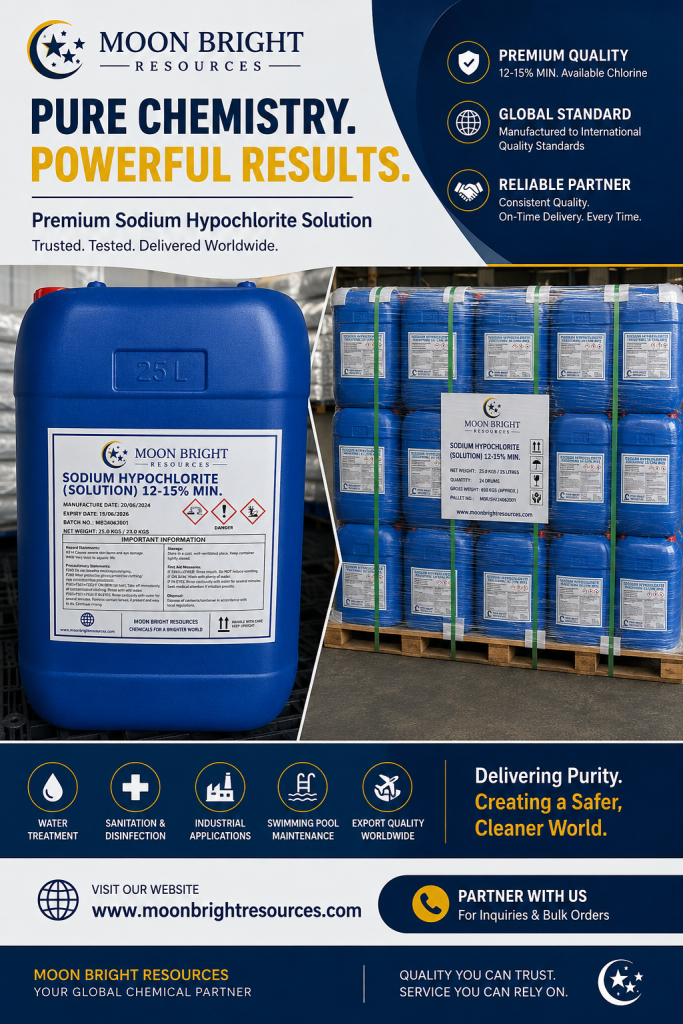
Moon Bright Resources lists sodium hypochlorite grades including 10% and 15% available chlorine on its product information.
For current specifications and available packaging options, buyers should refer to the sodium hypochlorite product specifications.
Why Sodium Hypochlorite Concentration Can Change
One of the challenges with sodium hypochlorite is that its strength can decrease over time.
Sodium hypochlorite is not a completely static product. Its decomposition is influenced by factors including:
- Temperature
- Light exposure
- Storage duration
- Concentration
- Contamination
- Storage conditions
- Container compatibility
This means that the concentration specified at manufacture or dispatch should be considered together with transportation time, storage conditions and expected consumption.
For bulk buyers, this is an important reason to establish appropriate stock rotation rather than assuming that a large inventory will always provide the best commercial result.
Sodium Hypochlorite Quality Testing
Testing provides a way of verifying that supplied material conforms to the agreed specification.
The appropriate analytical method depends on the parameter being measured and the required accuracy.
For available chlorine, iodometric titration is a commonly used analytical approach. Field testing can also be useful for operational monitoring where appropriate.
For a commercial purchase, the buyer and supplier should establish:
- Which parameters will be tested
- Which test methods will be used
- The acceptance limits
- Whether testing is performed before shipment
- Whether incoming testing is required
- How non-conforming material will be handled
A defined testing procedure helps prevent disagreements between buyer and supplier after delivery.
What Is a Certificate of Analysis for Sodium Hypochlorite?
A Certificate of Analysis (COA) provides batch-specific information about a supplied chemical.
A useful COA should allow the buyer to identify the product and relate the test results to the particular batch supplied.
Depending on the agreed specification, a sodium hypochlorite COA may include:
- Product name
- Batch or lot number
- Manufacturing or test date
- Available chlorine
- Free alkali
- Iron
- Specific gravity
- pH
- Other agreed parameters
- Specification limits
- Actual test results
- Authorised approval
The exact contents should be agreed between the buyer and supplier.
Importantly, a general product specification and a batch-specific COA serve different purposes.
The specification describes what the product is expected to meet.
The COA provides evidence of the tested characteristics of a particular batch.
Why Batch Traceability Matters
Batch traceability is particularly valuable for industrial chemical procurement.
If a problem occurs after delivery, the buyer should be able to identify:
- Which supplier supplied the material
- Which batch was delivered
- When it was manufactured or tested
- Which documentation accompanied the shipment
- Where the batch was stored
- When it entered production or treatment
Maintaining this information creates a documented chain between supplier, shipment, storage and final use.
For larger procurement programmes, batch traceability should be incorporated into the purchasing and quality-control process rather than treated as optional paperwork.
Sodium Hypochlorite Impurities
Sodium hypochlorite quality is also affected by impurities.
Depending on the application, buyers may establish limits for substances such as iron and other contaminants.
This becomes especially important where the chemical is being used in sensitive treatment processes or where the finished application has additional regulatory requirements.
Rather than using a generic “high purity” claim, professional buyers should request a defined specification showing the relevant parameters and acceptable limits.
Sodium Hypochlorite pH and Free Alkali
pH and free alkali are additional parameters that can be relevant when assessing sodium hypochlorite quality.
Sodium hypochlorite solutions are strongly alkaline. Free alkali contributes to the chemical environment of the solution and can be included within the product specification.
For industrial procurement, the important principle is consistency: the buyer should define the acceptable range and ensure that supplied batches are assessed against that specification.
Sodium Hypochlorite Stability and Storage
Quality management continues after the product has been delivered.
Sodium hypochlorite should be stored according to the supplier’s SDS, applicable regulations and site-specific risk assessment.
Appropriate storage planning should take into account:
- Temperature
- Sunlight
- Ventilation
- Container material
- Storage duration
- Separation from incompatible chemicals
- Spill containment
- Stock rotation
Acids and sodium hypochlorite, for example, must be kept appropriately separated because incompatible chemical mixing can create hazardous conditions.
Storage conditions can also influence product stability, so warehouse management is part of maintaining chemical quality.
Sodium Hypochlorite SDS: Why It Matters
The Safety Data Sheet (SDS) is an essential document for chemical users.
It provides information relevant to:
- Hazards
- Handling
- Storage
- Personal protection
- Accidental release
- First aid
- Fire response
- Transport
- Disposal
- Chemical incompatibilities
Before accepting a commercial sodium hypochlorite shipment, the buyer should ensure that the current SDS is available to the personnel responsible for receiving, storing and using the chemical.
The SDS should be considered alongside the product specification and site-specific safety procedures.
Sodium Hypochlorite Compliance and Drinking Water
The compliance requirements for sodium hypochlorite depend heavily on the intended application.
For drinking-water treatment, commercial hypochlorite supplied to water utilities falls within the scope of NSF/ANSI/CAN 60 — Drinking Water Treatment Chemicals – Health Effects. NSF explains that this standard applies to commercial bleach transported to utilities for drinking-water disinfection.
This distinction is important because not every sodium hypochlorite product on the market should automatically be assumed to be certified for drinking-water treatment.
Buyers should verify the actual product, facility and certification rather than relying solely on a supplier’s general statement.
The current NSF official listings demonstrate why this verification matters: different sodium hypochlorite products can have different certified uses, concentrations and maximum use levels. NSF
How to Verify NSF/ANSI/CAN 60 Certification
When a project requires NSF/ANSI/CAN 60 certification, procurement and quality teams should verify the specific product through the official NSF listings.
Look for:
- Manufacturer or certified facility
- Product name/trade designation
- Chemical
- Applicable standard
- Product function
- Maximum use level
- Relevant certification notes
NSF’s official listings also note that only products bearing the NSF Mark on the product, packaging and/or accompanying documentation are certified. NSF
For this reason, simply seeing “NSF” mentioned in a quotation or product description should not replace verification of the actual certification.
You can check the official NSF sodium hypochlorite certification listings when certification is relevant to your application.
NSF/ANSI/CAN 60 and Sodium Hypochlorite Testing
NSF provides specific information about hypochlorite treatment-chemical specifications and the parameters considered under NSF/ANSI 60.
Its technical material explains that hypochlorite chemicals used for drinking-water treatment are evaluated for parameters relevant to potential contaminants and health effects. NNSF+1
This reinforces an important procurement principle:
The appropriate sodium hypochlorite specification depends on the end use.
A product intended for an industrial application should not automatically be presented as equivalent to a product certified for drinking-water treatment.
AWWA and Sodium Hypochlorite
AWWA standards are also relevant to the water-treatment industry.
NSF’s current sodium hypochlorite certification listings reference AWWA B300, Hypochlorites, including recommendations concerning handling and storage of hypochlorite solutions. NSF
Where a project specification requires compliance with an AWWA standard, buyers should confirm the exact edition, product requirements and project applicability rather than relying on a general reference to “AWWA compliant.”
Quality Documentation Checklist
Before approving a sodium hypochlorite supplier, a quality or technical team should consider requesting:
- Product specification
- Certificate of Analysis
- Safety Data Sheet
- Batch/lot number
- Manufacturing or dispatch date
- Available chlorine result
- Relevant impurity results
- Packaging information
- Storage requirements
- Transport documentation
- Applicable certifications
- Regulatory declarations where required
For regulated applications, additional project-specific documentation may be required.
Sodium Hypochlorite Incoming Inspection
A practical incoming inspection procedure can be divided into several stages.
1. Document verification
Confirm the purchase order, product specification, COA, SDS and shipment documents.
2. Product identification
Check the product name, concentration, batch number and labels.
3. Packaging inspection
Inspect containers for damage, leakage or other signs of compromised packaging.
4. Batch verification
Ensure that the delivered batch corresponds with the accompanying COA.
5. Testing
Where required by the quality plan, test critical parameters such as available chlorine.
6. Acceptance
Compare the results with the agreed specification and document the acceptance decision.
This process can be scaled according to the volume, application and criticality of the chemical.
Questions to Ask a Sodium Hypochlorite Supplier
Before placing an order, technical and procurement teams can ask:
What available chlorine concentration is supplied?
What is the specification tolerance?
Can you provide a batch-specific COA?
Which analytical method is used for available chlorine?
What impurity parameters are controlled?
What is the expected product stability under recommended storage conditions?
What packaging options are available?
What SDS accompanies the product?
Which certifications apply to the specific grade?
Does the certification cover our intended application?
Can the batch be traced from production through delivery?
These questions help distinguish a supplier with a defined quality system from one that simply provides a chemical quotation.
Sodium Hypochlorite Quality Control: A Practical Framework
For recurring purchases, buyers can establish a simple quality-control framework:
Before purchase:
Define the required specification and applicable standards.
Before shipment:
Review the agreed documentation and batch requirements.
At delivery:
Inspect packaging, identification and documentation.
After receipt:
Perform incoming testing where required.
During storage:
Monitor conditions and maintain stock rotation.
During use:
Monitor concentration or available chlorine according to the site’s operating procedure.
This approach treats quality as a continuous process rather than something checked only when the chemical arrives.
Choosing a Sodium Hypochlorite Supplier
The lowest quoted price does not necessarily represent the lowest overall procurement cost.
A quality-focused supplier should be able to provide:
- Defined product specifications
- Consistent batches
- Appropriate documentation
- Suitable packaging
- Technical information
- Traceability
- Reliable logistics
- Support for applicable compliance requirements
For buyers evaluating sodium hypochlorite for commercial or industrial use, the product specification should be matched to the actual application.
You can review the available sodium hypochlorite grades, specifications and packaging options on the Moon Bright Resources sodium hypochlorite product page.
Frequently Asked Questions
How do you determine sodium hypochlorite quality?
Quality can be assessed using parameters such as available chlorine, free alkali, impurities, specific gravity, pH, stability and batch documentation. The relevant parameters depend on the intended application.
How is sodium hypochlorite concentration tested?
Available chlorine can be determined using appropriate analytical methods such as iodometric titration. The testing method and acceptance criteria should be established according to the application and quality specification.
What is a COA for sodium hypochlorite?
A Certificate of Analysis provides batch-specific test information showing whether the supplied material meets defined quality parameters.
Does sodium hypochlorite need an SDS?
Commercial users should have access to the applicable Safety Data Sheet and follow its handling, storage, emergency and transport information.
Is all sodium hypochlorite NSF certified?
No. NSF certification applies to specific products and facilities. The official NSF listings should be checked to verify whether the particular product is certified and what use restrictions apply. NSF
What is NSF/ANSI/CAN 60?
NSF/ANSI/CAN 60 is the standard covering health effects of drinking-water treatment chemicals. NSF states that commercial hypochlorite bleach transported to water utilities for drinking-water disinfection falls under this standard. NSF
Why does sodium hypochlorite lose strength?
Sodium hypochlorite can degrade over time, with factors such as temperature, light, concentration and storage conditions affecting stability.
What should be checked on delivery?
At minimum, buyers should verify product identity, concentration, batch number, packaging condition and accompanying documentation. Where required, incoming laboratory testing should also be performed.
Conclusion
Sodium hypochlorite quality is more than a number on a quotation.
For professional buyers, a reliable quality assessment combines available chlorine, chemical specifications, impurity control, stability, testing, batch traceability, documentation and applicable standards.
For regulated applications such as drinking-water treatment, certification should be verified against the specific product and facility rather than assumed from a general supplier claim. NSF’s official resources provide a useful reference for checking sodium hypochlorite products covered by NSF/ANSI/CAN 60. NNSF+1
For commercial requirements, review the sodium hypochlorite product specifications and available packaging options and contact Moon Bright Resources with your required concentration, quantity, application and destination.

 English
  French
  Arabic
  Spanish
  Bulgarian