
coconut shell vs coal based activated carbon
Quick Answer for Industrial Procurement:
Choosing the correct activated carbon substrate depends entirely on the molecular weight of the target contaminant. Coconut shell activated carbon is highly microporous ($< 2 \text{ nm}$), making it the gold standard for trace volatile organic compounds (VOCs), chlorine, and high-purity municipal water treatment. Coal-based carbon possesses a dual micro-mesoporous structure suited for general industrial wastewater, while wood-based carbon is highly mesoporous and macroporous ($> 50 \text{ nm}$), making it the ideal choice for large-molecule decolorization in food, beverage, and pharmaceutical processing.
Table of Contents
- #introduction – Introduction: The Role of the Raw Substrate
- #porosity-science – The Science of Porosity: Micropores, Mesopores, and Macropores
- #comparative-analysis – Head-to-Head Material Performance Comparison
- #mechanical-durability – Mechanical Durability and Attrition Resistance
- #operational-kinetics – Operational Kinetics and Adsorption Capacity
- #logistics-compliance – Shipping Safety and Compliance under IMDG 42-24 (2026 Standards)
- #faqs – Frequently Asked Questions (FAQ)
1. Introduction: The Role of the Raw Substrate coconut shell vs coal based activated carbon
In B2B chemical procurement and process engineering, choosing an adsorbent medium is one of the most critical factors influencing a filtration system’s operational lifecycle. While all activated carbons look like simple black granules or powders, their performance profiles are highly distinct.
The thermal activation process—typically utilizing high-temperature steam in a rotary kiln at temperatures ranging from $800^\circ\text{C}$ to $1100^\circ\text{C}$—carves out millions of microscopic cavities within the carbon matrix. However, the raw material used as the base substrate acts as the biological blueprint for these cavities.
Whether you are designing a Municipal drinking water treatment plant, an industrial VOC abatement system, or a pharmaceutical purification loop, the physical origin of your carbon—be it coconut shell, bituminous coal, or wood—predetermines how successfully your system will capture target contaminants.
For procurement managers looking to optimize filter run times and reduce total cost of ownership, understanding these material boundaries is essential. Choosing the wrong carbon substrate leads directly to premature contaminant breakthrough, system downtime, and high replacement costs.
2. The Science of Porosity: Micropores, Mesopores, and Macropores
To understand how activated carbon functions at an engineering level, we must analyze the internal surface geometry of the carbon particle. Adsorption is a surface-based phenomenon governed by weak physical forces (Van der Waals forces). The efficiency of this process relies on matching the pore diameter of the adsorbent to the molecular diameter of the adsorbate (contaminant).
The International Union of Pure and Applied Chemistry (IUPAC) classifies these internal cavities into three distinct pore size classes:
- Micropores (Diameter $< 2 \text{ nm}$): These tiny pores match the molecular size of small, volatile compounds, free chlorine, trihalomethanes (THMs), and low-molecular-weight solvents.
- Mesopores (Diameter $2 \text{ nm} – 50 \text{ nm}$): These intermediate pores are optimized for larger organic molecules, such as humic acids, dyes, synthetic colorants, and medium-chain hydrocarbons.
- Macropores (Diameter $> 50 \text{ nm}$): While macropores provide negligible surface area for actual adsorption, they serve as crucial entrance channels, allowing fluids to diffuse rapidly into the inner networks of the carbon granule.
       [Raw Substrate]  ──►  [Pore Size Distribution]  ──►  [Target Contaminant]

       Coconut Shell    ──►  Micropores (< 2 nm)       ──►  VOCs, Solvents, Chlorine
       Bituminous Coal  ──►  Micro/Mesopores (2-50 nm) ──►  Mixed Organics, Wastewater
       Hardwood/Wood    ──►  Macropores (> 50 nm)      ──►  Proteins, Dyes, Decolorization
Because of its high natural density and cell structure, steam-activated coconut shell carbon develops an overwhelmingly microporous profile, with up to 90% of its total pore volume consisting of cavities under $2 \text{ nm}$.
Conversely, bituminous coal-based carbon possesses a more transitional, dual pore structure (combining both micro and mesopores). Wood-based carbon features a highly open, macroporous network that acts like a sponge for large molecular chains but lacks the density required for trapping tiny molecules.
3. Head-to-Head Material Performance Comparison
When evaluating a raw material substrate, engineers must match the physical and chemical properties of the media to their specific system constraints. The table below outlines the core parameters across all three major carbon types:
| Specification Parameter | Coconut Shell Activated Carbon | Bituminous Coal Activated Carbon | Wood-Based Activated Carbon |
| Dominant Pore Geometry | Microporous ($< 2 \text{ nm}$) | Dual Micro/Mesoporous ($2 – 50 \text{ nm}$) | Macroporous ($> 50 \text{ nm}$) |
| Typical Iodine Value | $950 – 1150+ \text{ mg/g}$ | $800 – 1000 \text{ mg/g}$ | $600 – 800 \text{ mg/g}$ |
| Surface Area ($N_2$ BET) | $1050 – 1300 \text{ m}^2/\text{g}$ | $900 – 1100 \text{ m}^2/\text{g}$ | $700 – 1000 \text{ m}^2/\text{g}$ |
| Ball-Pan Hardness (ASTM D3802) | $97\% – 99\%$ (Very High) | $90\% – 95\%$ (Medium) | $60\% – 75\%$ (Low / Brittle) |
| Typical Ash Content | $1\% – 4\%$ | $8\% – 15\%$ | $3\% – 6\%$ |
| Apparent Density | $0.44 – 0.52 \text{ g/cm}^3$ | $0.46 – 0.54 \text{ g/cm}^3$ | $0.25 – 0.35 \text{ g/cm}^3$ |
| Water Soluble Ash / Leaching | Extremely Low | Moderate to High | Low to Moderate |
| Regeneration Lifecycles | High (Multi-cycle capacity) | Medium | Very Low (Degrades rapidly) |
The Sourcing Advantage of Coconut Shell
From a procurement perspective, coconut shell carbon represents the highest-purity substrate available. The naturally low mineral ash content (typically $< 3\%$) minimizes the risk of inorganic compounds leaching back into pure process water streams. This is a critical quality differentiator over bituminous coal-based media, which naturally carries high native concentrations of silica, iron, and heavy metals that can cause water pH spikes or compromise downstream reverse osmosis membranes.
4. Mechanical Durability and Attrition Resistance
In industrial applications, activated carbon granules are subjected to continuous mechanical stress. Undergoing packaging, transport, initial wetting, high-pressure hydraulic flows, and aggressive routine backwashing can quickly pulverize weak media.
The Problem with Soft Carbon: Fines and Pressure Drops
When a carbon granule breaks down due to mechanical attrition, it generates microscopic carbon dust particles known as fines. These fines cause severe operational issues:
- System Clogging: Carbon fines migrate down the filter column, blinding the underdrain nozzles and clogging support gravel beds.
- Pressure Spikes: As fines fill the void spaces between healthy carbon granules, the hydraulic resistance of the bed increases exponentially, requiring higher pump pressures and energy consumption.
- Material Loss: During backwash cycles, lightweight fines are suspended and washed out of the top of the vessel, resulting in a direct, unrecoverable loss of filter media.
       [Mechanical Friction / Backwash]
                      │
                      ▼
         [Carbon Particle Breakdown]
                      │
        ┌─────────────┴─────────────┐
        ▼                           ▼
  [Fines Generation]         [Bed Compaction]
        │                           │
        ▼                           ▼
  [Downstream Clogging]    [Severe Pressure Drop]
Ball-Pan Hardness Scores
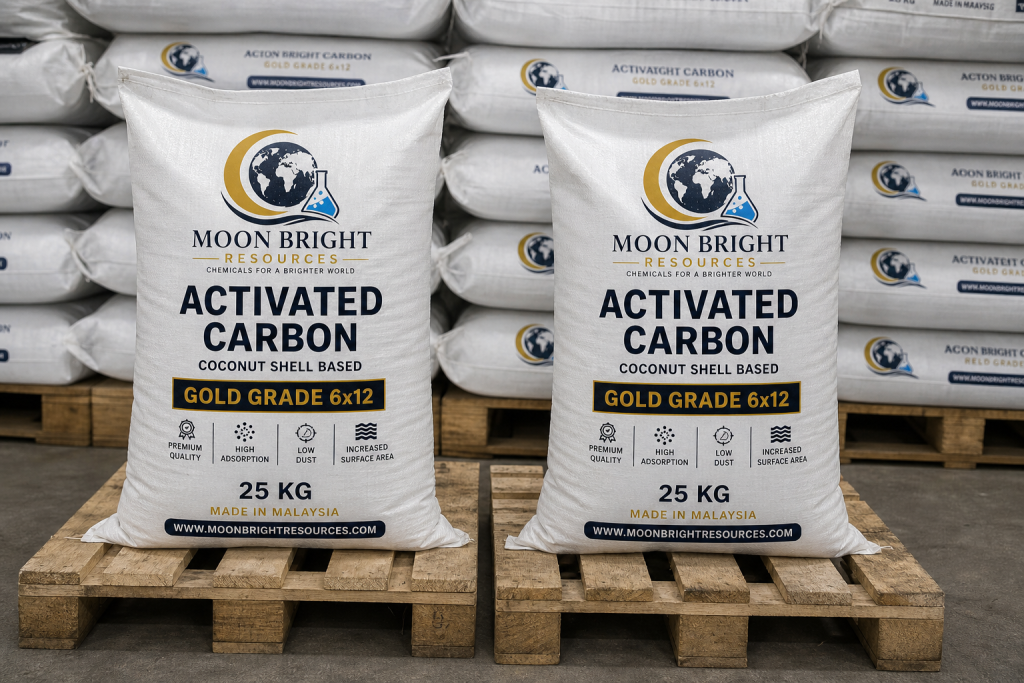
According to the ASTM D3802 standard ball-pan hardness test, coconut shell activated carbon scores an industry-leading 97% to 99%. Because coconut shells are naturally dense and highly lignified, their structural matrix is incredibly resilient.
Bituminous coal-based media averages a moderate 90% to 95%, which is suitable for standard wastewater treatment but prone to dust generation in highly dynamic, high-pressure systems.
Wood-based carbon rarely exceeds a hardness of 75%, meaning it possesses virtually no physical resistance to backwash forces and is therefore almost exclusively processed into Powdered Activated Carbon (PAC) for single-use applications rather than reusable granules.
5. Operational Kinetics and Adsorption Capacity
Understanding how quickly a carbon bed can reach its target treatment capacity is key to designing an efficient adsorption system. This dynamic is dictated by Empty Bed Contact Time (EBCT), which represents the average time a fluid dwells within the active carbon bed.
$$\text{EBCT} = \frac{V_B}{Q}$$
Where:
- $V_B$ is the volume of the carbon bed ($\text{m}^3$)
- $Q$ is the volumetric flow rate of the fluid ($\text{m}^3/\text{s}$)
Coconut Shell Kinetics: Rapid Microporous Adsorption
Due to its dense micropore structure, coconut shell GAC is optimized for rapid adsorption kinetics when targeting trace pollutants. Because the pores match the size of small organic molecules perfectly, the thermodynamic drive for the contaminants to leave the water phase and bind to the carbon surface is extremely high.
This allows systems using high-quality coconut shell GAC to operate efficiently at shorter EBCTs, enabling engineers to design smaller filtration vessels and save precious manufacturing footprint.
Coal-Based Kinetics: Broad Spectrum Capacity
When a process stream contains a complex, highly loaded mixture of both large and small organic molecules (such as industrial landfill leachate or municipal secondary effluent), coconut shell GAC can face limitations. The larger organic chains can physically block the entrances to the micropores, preventing the smaller compounds from accessing active adsorption sites—a phenomenon known as pore blinding.
In these scenarios, bituminous coal-based carbon performs exceptionally well. Its transitional mesoporous structure allows larger compounds to enter and adsorb within the wider pore networks without restricting access to the inner micropores, making it the superior “broad-spectrum” workhorse.
6. Shipping Safety and Compliance under IMDG 42-24
For global supply chain and logistics managers, the regulatory landscape governing the maritime transport of carbon-based materials changed dramatically on January 1, 2026.
Historically, many ocean carriers accepted shipments of activated carbon as non-hazardous cargo under various exemptions if the shipper provided a self-heating laboratory test certificate (the UN N.4 test). However, following a series of serious container fires on cargo vessels caused by self-heating coals and improperly weathered charcoals, the International Maritime Organization (IMO) introduced Amendment 42-24 to the IMDG Code, which is now fully mandatory.
                     [IMDG Code Amendment 42-24]
                     Mandatory: Jan 1, 2026
                                │
        ┌───────────────────────┴───────────────────────┐
        ▼                                               ▼
  [UN 1361: Charcoal]                            [UN 1362: Activated Carbon]
  * Classified as Class 4.2 Dangerous Goods      * Exemption ONLY possible under SP 979
  * NO N.4 self-heating test exemptions allowed  * Steam-Activated requires Shipper Certificate
  * Mandatory 14-day weathering protocol         * Chemically Activated requires lab test proof
The New Rules for UN 1362 (Activated Carbon)
Under the updated regulations, the safety classification depends directly on the activation method used to manufacture the carbon:
- Steam-Activated Carbon (The Coconut Shell Advantage): Steam-activated carbons (such as premium coconut shell carbons) are exempted from full Class 4.2 Dangerous Goods regulations under Special Provision 979 (SP979). To secure this non-DG booking status, the shipper must provide a formal signed and stamped declaration on company letterhead explicitly certifying that the material is steam-activated.
- Chemically Activated Carbon (Acid/Base Treatment): Carbons activated via chemical treatments (common in wood-based carbons and some coal types) remain classified under UN 1362, Class 4.2 (Substances liable to spontaneous combustion). To bypass DG shipping surcharges, the manufacturer must provide a certified laboratory test report proving the material passed a negative UN N.4 self-heating test.
For B2B procurement, sourcing steam-activated coconut shell carbon significantly simplifies the global supply chain, shielding your cargo from expensive Dangerous Goods surcharges, complex port inspections, and carrier rejections.
7. Frequently Asked Questions (FAQ)
What makes coconut shell activated carbon the best choice for VOC removal?
Coconut shell carbon is naturally rich in micropores (cavities with a diameter of less than $2 \text{ nm}$). Because volatile organic compounds (VOCs) are small molecules, their size matches these micropores perfectly, maximizing physical adsorption capacity and retention efficiency compared to mesoporous alternatives.
Why is coal-based activated carbon widely used in industrial wastewater treatment?
Coal-based carbon has a dual micro-mesoporous pore structure. This transitional structure is highly effective for wastewater treatment because it can adsorb a wide range of different molecular sizes simultaneously—from small solvents to larger synthetic dyes and humic acids—preventing pore-blinding issues.
Can wood-based activated carbon be regenerated for multiple uses?
Generally, no. Wood-based carbon has a low ball-pan hardness rating (often under 75%), making it highly brittle. When exposed to the intense mechanical and thermal stresses of a regeneration furnace, wood carbon easily breaks down into unusable dust (fines), meaning it is primarily used as a disposable, single-use media.
What are the shipping rules for activated carbon under IMDG 42-24?
Under the mandatory IMDG 42-24 rules, steam-activated carbon can travel as non-hazardous cargo provided the shipper issues a formal certificate declaring its steam-activated status. Chemically activated carbon is classified as UN 1362 Class 4.2 (Dangerous Goods) unless it passes a negative UN N.4 self-heating test from an accredited laboratory.
bulk activated carbon procurement guidelines,
sourcing coconut shell activated carbon in bulk,
high-iodine activated carbon wholesale,
granular activated carbon wholesale bulk pricing,
municipal water treatment carbon specifications,
bulk adsorbent media sourcing options,
activated carbon bulk density and packaging specs,
how activated carbon adsorbs heavy metals,
regenerating granular activated carbon lifespan,
industrial water purification carbon standards,
AWWA B604 compliance water treatment,
VOC removal efficiency of activated carbon,
food and beverage grade activated carbon specs,
activated carbon filter pressure drop calculation,
B2B activated carbon suppliers Malaysia,
commercial air filtration media procurement,
industrial water treatment chemical supply,
granular activated carbon mesh size chart,
difference between GAC and PAC,
IMDG code SP979 activated carbon,

 English
  French
  Arabic
  Spanish
  Bulgarian