
1. Executive Summary: The State of Global Mercury Procurement in 2026
“bulk liquid mercury wholesale”
The international market for elemental heavy metals is undergoing unprecedented tightening. For supply chain managers, procurement officers, and lab directors, locating reliable, legal channels for chemical logistics requires balancing technical product data with a complex web of environmental treaties. As global mandates actively phase out non-essential applications of heavy chemicals, the remaining legal markets—specifically precision laboratory testing, specialized electronics, and advanced material metrics—face stringent surveillance.
Navigating this procurement field requires deep comprehension of international standards, legal cross-border transfer procedures, and strict chemical certifications. This guide acts as an operational blueprint for commercial entities to handle sourcing bottlenecks, review specialized product definitions, and structure legally sound corporate purchasing practices.
2. Navigating the International Regulatory Grid: The Impact of the Minamata Convention
The defining framework for modern liquid mercury logistics is the Minamata Convention on Mercury, which entered a highly restrictive intersessional enforcement phase following the late-2025 COP-6 summit in Geneva. Legitimate supply lines are bound by Article 3 (Supply and Trade) and Article 11 (Waste Thresholds), which dictate the tracking and destination mapping of every metric ounce of elemental heavy metal globally traded.
Plaintext
       [Manufacturer / Legal Sourcing]
                     │
                     ▼
       [State Export Prior Informed Consent (PIC)]
                     │
                     ▼
       [UN-Approved Hazard Certification Tracking]
                     │
                     ▼
       [End-User Verification & Industrial Storage]
Under these codes, a commercial entity cannot simply locate a generic distributor. Transactions across borders demand formal Prior Informed Consent (PIC) documentation from both the exporting and importing nations’ environmental departments. Furthermore, with the European Union implementing Delegated Regulation (EU) 2026/55, traditional sourcing structures face an absolute ban on manufacturing, importing, and exporting a wide variety of mercury-added products and compounds. For corporate compliance teams, this means procurement must happen under rigid legal exemptions—such as designated calibration standards, scientific research, or specialized military-civil protection infrastructure.
3. Demystifying Industrial Keywords & Commercial Intent
When structuring enterprise supply lines or auditing search metrics for industrial chemical marketing, understanding search intent is vital. Buyers looking for specialized materials use distinct long-tail terminology depending on their industry vertical, location, and volume requirements.
Digital Search Profiles for Industrial Chemicals
In global digital marketing, identifying the difference between generic informational terms and transactional phrases determines campaign profitability. For example, searches like “liquid mercury for sale” o “where I can purchase metallic mercury” typically indicate a buyer starting their transactional journey. Conversely, phrases like “order liquid mercury flask” o “bulk liquid mercury wholesale” signal high-volume corporate procurement intents.
                  ┌──────────────────────────────┐
                  │      Informational Intent    │
                  │   "What is metallic mercury" │
                  └──────────────┬───────────────┘
                                 │
                                 ▼
                  ┌──────────────────────────────┐
                  │     Commercial Investigation │
                  │  "Where to buy liquid mercury"│
                  └──────────────┬───────────────┘
                                 │
                                 ▼
                  ┌──────────────────────────────┐
                  │      High Transactional      │
                  │ "Order liquid mercury flask" │
                  └──────────────────────────────┘
By mapping these search signals, B2B chemical distribution firms can optimize their digital architectures to capture organic purchasing traffic while maintaining complete transparency regarding required end-user documentation.
4. Technical Classifications: Purity Standards and Packaging Metrics
To structure a commercial contract with a verified distributor, procurement officers must accurately define the chemical grade required for their specific application. Substituting low-grade elements in scientific environments can compromise calibration mechanisms, cause tool degradation, or compromise laboratory accuracy.
Purity Tier Breakdown
Industrial and laboratory-grade liquid mercury is measured by its decimal purity, often classified by a number followed by an “N” (representing the number of nines):
- 4N Purity (99.99%): Commonly referred to in global industrial trade as “buy liquid mercury 99.99%” o “buy virgin liquid mercury”. This grade serves as the baseline for industrial electronic component manufacturing and large-scale pressure calibration instruments.
- 5N Purity (99.999%): A specialized chemical-grade solution used heavily in analytical instrumentation, high-accuracy thermometer manufacturing, and vacuum engineering setups.
- 6N Purity (99.9999%): The highest tier of triple-distilled chemical design, used primarily in aerospace engineering applications and crystal growth research.
Standard Storage and Trade Volumes
Because metallic mercury is exceptionally dense ($\approx 13.5 \text{ g/cm}^3$), packaging requirements are entirely unique compared to standard liquid logistics.
$$\text{Density} = \frac{\text{Mass}}{\text{Volume}} \implies 13.5 \text{ g/cm}^3 \approx 13,500 \text{ kg/m}^3$$
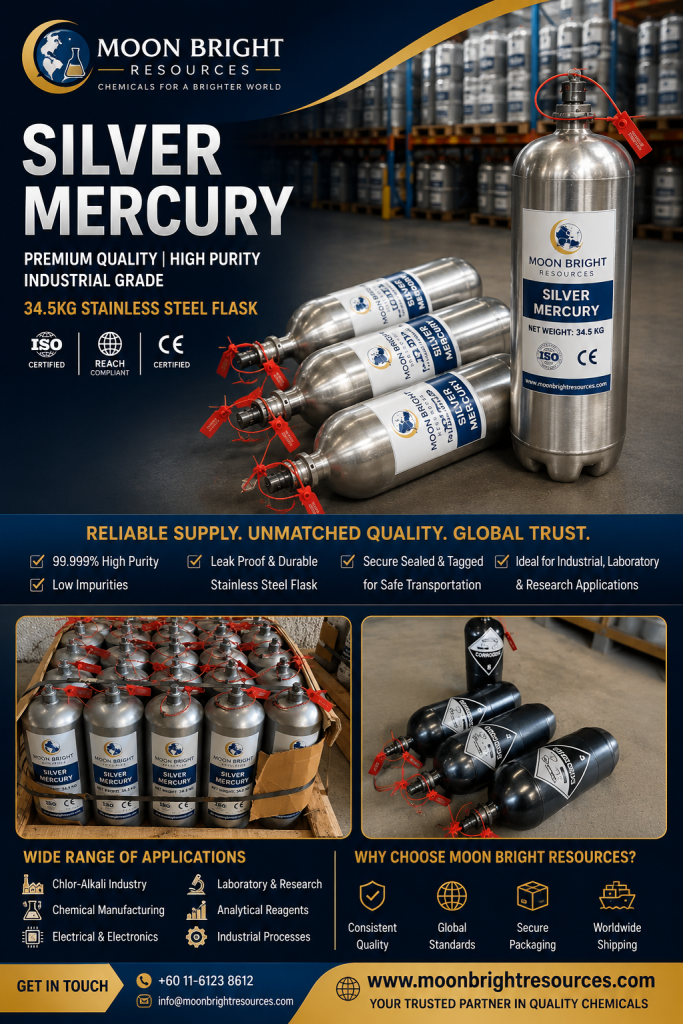
The standardized commercial shipping vessel globally acknowledged by customs and maritime shipping groups is the traditional steel flask.
| Packaging Code | Total Net Weight | Primary Commercial Domain |
| Micro-Ampoule | 1 to 25 Grams | Medical Research Reference Standards |
| Laboratory Jar | 1 to 5 Pounds | University Chemistry Calibration Labs |
| Standard Steel Flask | 34.5 Kilograms (76 lbs) | Global Bulk Industrial Wholesale |
5. Mapping the Global B2B Chemical Supply Chain
When procurement leads run localized geo-targeted searches like “liquid mercury suppliers near me” o “where to buy liquid mercury online”, they encounter a highly fragmented marketplace. Because hazardous chemical shipping cannot utilize conventional postal networks or standard courier routes, “near me” logistics usually translate to partnering with a licensed regional hazardous material carrier that docks at authorized container yards.
[Global Refinery] ──► [Maritime Hazmat Freight] ──► [Regional Tier-1 Depot] ──► [Enterprise End-User]
Navigating Tier-1 Distributors vs. Broker Networks
Legitimate enterprise procurement relies entirely on Tier-1 chemical manufacturers or direct authorized agents. Broker networks operating on unverified online forums often lack the ability to provide an officially certified Certificado de Análisis or a verified Ficha de Datos de Seguridad (FDS). Purchasing through unauthorized channels introduces immense corporate risk, including regulatory seizure, cross-border customs penalties, and civil liabilities under local hazardous substance laws.
6. Addressing Past Industrial Niches: Structural Adjustments and Policy Changes
Historically, specific long-tail keyword sets tracked legacy industrial operations across various extraction sectors. Terms like “liquid mercury for gold panning”, “industrial mercury for gold amalgamation”, y “quicksilver for small scale gold mining” were common components of older industrial chemical marketing frameworks. Similarly, “liquid mercury for silver mining ore” was heavily searched during the height of late-20th-century ore processing designs.
[IMAGE TAG: An infographic explaining the modern industrial evolution from historical mercury-heavy extraction processes to 21st-century chemical-free separation technologies.]
However, under modern environmental mandates, global policy has systematically decoupled elemental mercury from small-scale mining applications. International development funds, overseen by groups like the Global Environment Facility (GEF), are actively deploying millions of dollars into developing nations to transition small-scale operators to mercury-free alternative processing methods (such as direct smelting, borax extraction, and automated concentration tables).
Consequently, modern chemical marketing strategies must refocus their digital positioning. Content previously geared toward raw extraction must pivot toward remediation technologies, closed-loop recycling systems, and the legal distribution of technical calibration alternatives.
7. Safety, Risk Assessment, and Storage Standards in Facilities
Sourcing high-purity chemicals is only half the battle; storing them legally within an industrial facility requires meticulous engineering. Because liquid mercury exhibits high vapor pressure even at standard room temperature ($20^\circ\text{C}$), inadequate storage spaces quickly turn into hazardous zones due to invisible chemical off-gassing.
                  ┌─────────────────────────────────┐
                  │    Secondary Containment Tray   │
                  │  ┌───────────────────────────┐  │
                  │  │     Primary Steel Flask   │  │
                  │  └───────────────────────────┘  │
                  └─────────────────────────────────┘
                  ▲                                 ▲
                  └────── Stainless Steel Lip ──────┘

Essential Facility Storage Frameworks
- Secondary Containment Systems: All storage areas must feature non-porous, smooth epoxy-coated floors or stainless steel trays designed with high perimeter lips. If a spill occurs, these containment fields prevent the chemical from fracturing into micro-droplets and sinking into concrete pores.
- Dedicated HVAC Infrastructure: Storage depots require isolated, negative-pressure ventilation layouts that exhaust directly through activated carbon filtration screens before venting outside, completely independent of a building’s central air handling system.
- Ambient Monitoring Systems: High-sensitivity electronic vapor analyzers should be strategically mounted at floor level (as heavy chemical vapors settle downward) to provide early warnings of primary flask seal failure.
8. Sourcing Logistics: Invoicing, Shipping, and Final Delivery
When a corporate buyer issues a formal request for a quote using transactional triggers like “order liquid mercury flask“, the vendor’s legal team must trigger an automated Know Your Customer (KYC) vetting matrix.
               ┌──────────────────────────────────────┐
               │    Buyer Submits RFQ & Facility ID   │
               └──────────────────┬───────────────────┘
                                  │
                                  ▼
               ┌──────────────────────────────────────┐
               │  Compliance Check: End-User Accord   │
               └──────────────────┬───────────────────┘
                                  │
                                  ▼
               ┌──────────────────────────────────────┐
               │  Hazmat Route Clearance & Freight     │
               └──────────────────┬───────────────────┘
                                  │
                                  ▼
               ┌──────────────────────────────────────┐
               │     Final Delivery & Chain Sign-off  │
               └──────────────────────────────────────┘
The Institutional Onboarding Checklist
Before an invoice for high-purity chemical components is approved, procurement agents must provide:
- A valid commercial business address and corporate tax registration ID.
- A signed End-User Declaration stating the precise intended laboratory or calibration use.
- Proof of operational capability to receive hazardous materials class 8 (corrosive substances) and class 6.1 (toxic substances) at their receiving dock.
Once verified, freight forwarders transport the material utilizing specialized, impact-tested transport vaults, ensuring the shipment satisfies both domestic department of transportation guidelines and international maritime laws.
9. Conclusion: Securing Sustainable and Compliant Chemical Networks
Managing a high-risk chemical inventory in 2026 demands absolute commitment to transparency, regulatory alignment, and proactive supply chain planning. By understanding technical definitions, choosing highly certified suppliers, and steering clear of unverified online marketplaces, corporate procurement teams can maintain smooth operations without running afoul of evolving international laws.
10. Frequently Asked Questions (FAQ)
What is the standard global trade unit for elemental mercury?
The globally recognized trade unit is the 34.5 kg (76 lb) steel flask. All wholesale market prices, import duties, and hazardous shipping metrics are calculated based on this specific container volume.
How does the Minamata Convention impact domestic procurement?
It restricts bulk transactions by requiring verified end-user declarations and certified export permissions. This prevents the redirection of high-purity industrial chemicals into unmonitored or illegal sectors.
Can a laboratory buy liquid mercury online without enterprise verification?
No. Legitimate chemical suppliers will not process transactions without checking corporate credentials, facility licenses, and destination safety profiles. This step is mandatory to minimize systemic public health risks.
99 % mercury for sale,
99.99 lab grade mercury,
99.99% mercury metal price,
can you legally buy mercury,
who sells liquid mercury,
1 litre mercury price,
mercury purchase online,
can you buy mercury liquid,
silver mercury for gold extraction,
liquid mercury for gold panning,
industrial mercury for gold amalgamation,
quicksilver for small scale gold mining,
how to use liquid mercury to recover gold,
liquid mercury for silver mining ore,

 English
  French
  Arabic
  Spanish
  Bulgarian