
Introduction
What Is Acetic Acid ?Acetic acid is one of the most widely used organic acids in modern industry. From manufacturing chemicals and pharmaceuticals to producing textiles, food ingredients, adhesives, and coatings, it plays an essential role in countless industrial processes around the world.
Although many people recognize acetic acid as the compound responsible for the characteristic taste and smell of vinegar, industrial acetic acid is produced to much higher purity levels and is used in applications that demand consistent quality and performance.
Whether you are a procurement specialist evaluating suppliers, a chemical engineer researching production processes, a laboratory professional reviewing material properties, or simply looking to understand this versatile chemical, this Authority Project provides a comprehensive overview of acetic acid, its characteristics, and its industrial significance. bulk acetic acid
Organizations requiring commercial quantities should work with a reliable industrial acetic acid supplier that can provide the appropriate purity grade, packaging options, and technical documentation for their intended application.
Quick Answer
Acetic acid (CH₃COOH) is a weak organic acid that occurs naturally in vinegar and is manufactured on an industrial scale for use in chemical production, pharmaceuticals, textiles, food processing, adhesives, coatings, and many other applications. Its concentrated form, commonly known as glacial acetic acid, is valued for its high purity and versatility across numerous industries.
Table of Contents
- What Is Acetic Acid?
- Chemical Formula and Molecular Structure
- Physical and Chemical Properties
- How Acetic Acid Is Manufactured
- Common Industrial Uses of Acetic Acid
- Industries That Depend on Acetic Acid
- Food Grade vs Industrial Grade Acetic Acid
- Storage and Handling Best Practices
- Environmental and Safety Considerations
- Moon Bright Insight
- Technical Snapshot
- Industry Spotlight
- Things to Know
- Frequently Asked Questions
- Questions & Answers
- Related Authority Projects
- References
- Conclusion
Moon Bright Insight
Acetic acid is more than a basic chemical ingredient—it is a foundational building block in global manufacturing. Its importance extends far beyond vinegar, supporting the production of advanced materials, pharmaceuticals, food ingredients, synthetic fibers, coatings, and countless industrial products. Understanding the different grades, properties, and applications of acetic acid helps organizations select the right material for their operational and quality requirements.
What Is Acetic Acid?
Acetic acid is an organic compound belonging to the carboxylic acid family and is represented by the chemical formula CH₃COOH. It is a clear, colorless liquid with a distinctive pungent odor that is commonly associated with vinegar. While diluted acetic acid is widely recognized as the principal component of household vinegar, industrial-grade acetic acid is produced at much higher concentrations and is an essential raw material in modern manufacturing.
Today, acetic acid serves as a fundamental building block for producing a wide range of chemicals and materials, including vinyl acetate monomer, acetic anhydride, acetate esters, purified terephthalic acid (PTA), synthetic fibers, coatings, adhesives, pharmaceuticals, and food ingredients. Its versatility has made it one of the most important organic acids used in global industry.
For organizations requiring consistent quality, high-purity material, or bulk quantities, working with an experienced Acetic Acid supplier helps ensure access to the appropriate concentration, documentation, and packaging for industrial applications.
A Brief History of Acetic Acid
Acetic acid has been known for thousands of years. Ancient civilizations discovered that when alcoholic beverages were exposed to air for extended periods, they naturally transformed into vinegar through fermentation. Long before the chemistry was understood, vinegar was already being used for food preservation, cleaning, and medicinal purposes.
During the nineteenth and twentieth centuries, advances in industrial chemistry transformed acetic acid from a naturally fermented product into a high-volume industrial chemical. Modern manufacturing methods now enable the production of high-purity acetic acid suitable for demanding applications in chemical synthesis, pharmaceutical manufacturing, textiles, plastics, and numerous other industries.
Chemical Formula and Molecular Structure
Acetic acid has the molecular formula:
CH₃COOH
It consists of two primary components:
- A methyl group (CH₃)
- A carboxyl group (COOH)
The carboxyl group is responsible for the acidic behavior of the molecule. Although acetic acid is classified as a weak acid because it only partially dissociates in water, it is highly effective in many industrial processes where controlled acidity is required.
Technical Snapshot
| Property | Value |
|---|---|
| Chemical Name | Acetic Acid |
| Molecular Formula | CH₃COOH |
| CAS Number | 64-19-7 |
| Chemical Family | Carboxylic Acid |
| Appearance | Clear, colorless liquid |
| Characteristic Odor | Sharp, vinegar-like |
| Common Industrial Form | Glacial Acetic Acid |
| Primary Industrial Role | Chemical intermediate and process chemical |
Moon Bright Insight
Although vinegar contains acetic acid, industrial acetic acid should not be confused with household vinegar. Industrial grades are manufactured to strict purity specifications and are intended for professional use in chemical processing, manufacturing, pharmaceuticals, textiles, food production, and other regulated industries.
For authoritative chemical identification and standardized property data, readers can consult the PubChem Acetic Acid record, which provides detailed molecular, physical, and toxicological information.
🧪 Technical Snapshot
Acetic acid is a well-characterized organic compound used across multiple industrial sectors. Below is a consolidated technical reference for procurement and engineering use.
| Property | Value |
|---|---|
| Chemical Name | Acetic Acid |
| Molecular Formula | CH₃COOH |
| CAS Number | 64-19-7 |
| Molecular Weight | 60.05 g/mol |
| Appearance | Colorless liquid |
| Odor | Pungent, vinegar-like |
| Density | ~1.049 g/cm³ (glacial form) |
| Melting Point | 16.6°C |
| Boiling Point | 118.1°C |
| Solubility | Fully miscible in water |
| Classification | Weak organic (carboxylic) acid |
| Industrial Form | Glacial / diluted grades |
🧪 Physical and Chemical Properties
Acetic acid is classified as a weak organic acid, meaning it does not fully dissociate in aqueous solutions. Despite this, it is highly reactive in industrial environments where controlled acidity is required.
Key characteristics include:
- Strong polarity due to the carboxyl group
- High miscibility with water and many organic solvents
- Ability to form esters and acetate derivatives
- Reactivity in neutralization and synthesis processes
- Stability under standard storage conditions when properly sealed
Because of these properties, acetic acid functions not only as an acid but also as a chemical intermediate, enabling the production of a wide range of downstream industrial products.
🏭 How Acetic Acid Is Manufactured
Industrial production of acetic acid has evolved significantly over time.
Today, the most common method is catalytic carbonylation of methanol, a highly efficient industrial process.
Simplified Process Flow:
- Methanol reacts with carbon monoxide
- A catalyst accelerates the reaction
- Acetic acid is formed and purified
- Final product is separated into required grades
This method allows large-scale, consistent production suitable for global supply chains.
Historically, acetic acid was also produced via:
- Oxidation of acetaldehyde
- Fermentation processes (for vinegar production)
However, these are now largely limited to niche or food applications.
🏭 Industry Spotlight
Acetic acid plays a critical role in multiple global industries:
Chemical Manufacturing
Used as a precursor for:
- Vinyl acetate monomer (VAM)
- Acetic anhydride
- Ester production
Textiles
Used in:
- Dyeing processes
- Fabric treatment
- Synthetic fiber production
Pharmaceuticals
Used in:
- Drug synthesis intermediates
- pH control processes
Food Industry
Used in:
- Acidity regulation
- Food-grade vinegar production
Plastics & Polymers
Used in:
- PET-related production chains
- Coatings and adhesives
💡 Moon Bright Insight
Acetic acid is not valuable because it is chemically complex—it is valuable because it is chemically versatile. Few industrial chemicals serve as both a solvent, a reactant, and a feedstock across so many industries. This versatility is what makes it one of the most widely traded organic acids globally.
📦 Procurement Note
When sourcing acetic acid for industrial applications, buyers typically evaluate:
- Required concentration (glacial vs diluted)
- Application sensitivity (food, pharma, chemical synthesis)
- Packaging type (drums, IBC tanks, bulk supply)
- Storage conditions and compatibility
- Supply consistency and documentation requirements
Selecting the correct specification is essential because different industries require different purity levels and handling standards.
⚠️ Compliance Corner
Acetic acid is generally classified as a corrosive chemical in concentrated form and must be handled in accordance with applicable safety regulations.
Key considerations include:
- Proper labeling and hazard classification
- Use of compatible storage materials
- Adequate ventilation during handling
- Compliance with transport regulations for corrosive substances
For detailed regulatory information, authoritative guidance can be found through chemical safety agencies and industrial standards bodies.
Common Industrial Uses of Acetic Acid
Acetic acid is one of the world’s most versatile industrial chemicals. Its unique combination of chemical stability, controlled acidity, and reactivity makes it an essential raw material in numerous manufacturing processes. Rather than serving a single purpose, acetic acid functions as a chemical intermediate, solvent, pH regulator, and processing aid across many industries.
As global manufacturing continues to expand, demand for high-quality acetic acid remains strong because it contributes to the production of thousands of finished products used every day.
📦 Procurement Note
Manufacturers should select the appropriate grade of acetic acid based on the intended application. Industrial, food-grade, and pharmaceutical applications may require different purity levels, quality documentation, and handling procedures. Organizations sourcing commercial quantities can refer to the Moon Bright Resources Acetic Acid Product Page (Internal Link) for available specifications and packaging options.
Chemical Manufacturing
Chemical manufacturing is the largest consumer of industrial acetic acid. It serves as a critical feedstock for producing numerous downstream chemicals that support global manufacturing.
Some of the most significant products derived from acetic acid include:
- Vinyl acetate monomer (VAM)
- Acetic anhydride
- Acetate esters
- Purified terephthalic acid (PTA)
- Cellulose acetate
These compounds are further used to manufacture adhesives, coatings, paints, synthetic fibers, plastics, packaging materials, and specialty chemicals.
💡 Moon Bright Insight
Although acetic acid is often viewed as a finished chemical product, its greatest economic value lies in serving as a building block for other industrial materials. This makes it an essential component of many global manufacturing supply chains.
Textile Industry
The textile industry relies on acetic acid throughout various production stages.
Common applications include:
- Neutralizing alkaline solutions after dyeing
- Adjusting pH during textile processing
- Improving dye fixation
- Assisting in fabric finishing operations
Its controlled acidity helps manufacturers achieve consistent color quality while protecting delicate fibers during processing.
Pharmaceutical Manufacturing
Pharmaceutical manufacturers use acetic acid as both a processing chemical and a chemical intermediate.
Applications include:
- Drug synthesis
- Production of pharmaceutical intermediates
- pH adjustment during manufacturing
- Laboratory reagent preparation
- Cleaning and equipment processing (where appropriate)
Because pharmaceutical production demands strict quality standards, the required grade and purity of acetic acid must align with applicable manufacturing and regulatory requirements.
Food and Beverage Industry
Food-grade acetic acid is widely used in food manufacturing due to its acidity and preservative properties.
Typical applications include:
- Vinegar production
- Food preservation
- Flavor formulation
- Acidity regulation
- Pickling processes
It is important to distinguish food-grade acetic acid from industrial-grade material. Each grade is manufactured and controlled according to its intended use and applicable quality standards.
Paints, Coatings and Adhesives
Acetic acid contributes to the manufacture of several materials used in protective coatings and adhesive formulations.
These products are found in industries such as:
- Construction
- Automotive manufacturing
- Furniture production
- Packaging
- Consumer goods
Many coating systems ultimately depend on chemicals that originate from acetic acid chemistry.
Plastics and Polymers
Modern plastics manufacturing depends heavily on chemical intermediates produced from acetic acid.
These include materials used in:
- Flexible packaging
- Plastic films
- Bottles
- Industrial containers
- Consumer packaging
- Polyester production
The widespread use of polyester textiles and PET packaging means that acetic acid indirectly contributes to countless everyday products.
Water Treatment
Certain industrial water treatment processes use acetic acid for controlled pH adjustment and specialized chemical applications.
The suitability of acetic acid depends on the treatment process, water chemistry, and regulatory requirements.
Operators should always follow applicable engineering practices and environmental regulations when selecting treatment chemicals.
Laboratory and Research Applications
Acetic acid is commonly used in:
- Analytical laboratories
- Educational laboratories
- Research institutions
- Chemical testing facilities
- Quality control laboratories
Its predictable chemical behavior makes it valuable in many laboratory procedures and analytical methods.
Agriculture
Within agriculture, acetic acid has specialized applications in manufacturing and processing. Depending on formulation and intended use, it may also be incorporated into certain agricultural products where permitted by local regulations.
Application requirements vary by region, making compliance with applicable regulations essential.
🏭 Industry Spotlight
Acetic acid supports some of the world’s largest industries.
| Industry | Primary Purpose |
|---|---|
| Chemical Manufacturing | Chemical intermediate |
| Textiles | Dyeing and finishing |
| Pharmaceuticals | Drug manufacturing |
| Food Processing | Acidity regulation and preservation |
| Paints & Coatings | Raw material production |
| Plastics | Polymer manufacturing |
| Water Treatment | Process chemistry |
| Research Laboratories | Analytical and scientific work |
This broad industrial adoption demonstrates why acetic acid remains one of the most important organic chemicals in commercial production.
💡 Did You Know?
Although consumers primarily associate acetic acid with vinegar, the majority of globally produced acetic acid is used in industrial manufacturing rather than food production. Large volumes are consumed in the production of vinyl acetate monomer and purified terephthalic acid, which are essential to industries ranging from packaging to textiles.
Choosing the Right Grade of Acetic Acid
Not all acetic acid is the same. Depending on the intended application, manufacturers, laboratories, and food processors require different purity levels, quality standards, and documentation.
Selecting the appropriate grade is essential for product performance, regulatory compliance, and operational safety.
The most common grades include:
| Grade | Typical Applications |
|---|---|
| Industrial Grade | Chemical manufacturing, textiles, coatings, adhesives, plastics |
| Food Grade | Food processing, vinegar production, acidity regulation |
| Laboratory Grade | Research, analytical testing, education |
| Pharmaceutical Grade | Drug manufacturing and specialized pharmaceutical processes |
Each grade is manufactured to meet specific quality requirements. Buyers should always verify that the selected material matches the intended application and any applicable industry standards.
📦 Procurement Note
Before placing an order, confirm the required purity, concentration, packaging format, and documentation (such as Certificates of Analysis or Safety Data Sheets). These requirements often differ between industries and applications.
Storage and Handling Best Practices
Proper storage helps maintain product quality while reducing operational and safety risks.
Although storage requirements vary depending on concentration and local regulations, the following practices are widely recommended:
- Store in tightly sealed, compatible containers.
- Keep away from incompatible chemicals such as strong oxidizing agents.
- Store in a cool, dry, and well-ventilated area.
- Protect containers from excessive heat and direct sunlight.
- Clearly identify storage areas and ensure appropriate hazard communication.
- Follow applicable workplace safety procedures and local regulations.
Personnel handling concentrated acetic acid should use appropriate personal protective equipment (PPE) and follow established workplace safety procedures.
⚠️ Compliance Corner
Industrial users should always consult the latest Safety Data Sheet (SDS) and comply with applicable national and international regulations governing storage, transportation, and handling.
Key considerations include:
- Hazard communication requirements
- Workplace exposure controls
- Chemical labeling
- Spill response procedures
- Waste disposal requirements
- Transportation classifications
Because regulations may vary by country or region, organizations should verify the specific requirements that apply to their operations.
💡 Moon Bright Insight
Safe chemical management is more than regulatory compliance—it protects employees, maintains product quality, and minimizes operational disruptions. Establishing clear handling procedures and regular staff training is just as important as selecting the right chemical grade.
Environmental Considerations
Responsible use of acetic acid includes proper storage, handling, and disposal practices.
Modern manufacturing facilities typically implement environmental management systems that help reduce waste, prevent accidental releases, and improve resource efficiency.
Organizations should:
- Follow approved disposal procedures.
- Prevent uncontrolled releases into the environment.
- Train personnel in spill response.
- Maintain appropriate secondary containment where required.
- Comply with local environmental regulations.
Many companies also integrate chemical management into broader sustainability initiatives aimed at improving operational efficiency and reducing environmental impact. acetic acid uses
📌 Things to Know About Acetic Acid
Before purchasing or using acetic acid, keep these key points in mind:
✅ Acetic acid is one of the world’s most important industrial organic acids.
✅ It is widely used as a chemical intermediate rather than as a finished product.
✅ Glacial acetic acid refers to highly concentrated acetic acid.
✅ Different industries require different grades and purity levels.
✅ Proper storage and handling are essential for maintaining product quality and workplace safety.
✅ Acetic acid is used across chemical manufacturing, food processing, textiles, pharmaceuticals, coatings, plastics, and laboratory applications.
✅ Always review technical documentation before selecting a supplier or specifying a grade.
💡 Did You Know?
The term “glacial acetic acid” comes from the compound’s ability to form ice-like crystals at temperatures just below ordinary room temperature (approximately 16.6°C or 61.9°F). This distinctive property gave rise to the name “glacial,” even though the material is a liquid under most industrial storage conditions. acetic acid uses
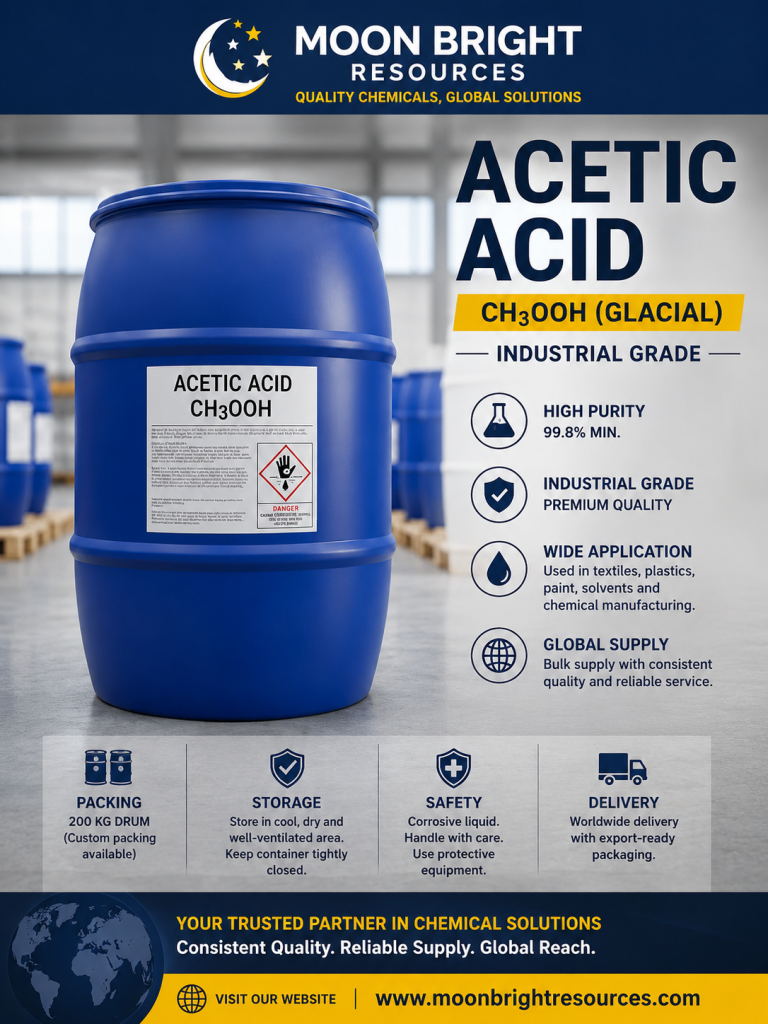
Preparing to Source Acetic Acid
Whether you’re purchasing for manufacturing, laboratory work, or food production, choosing the right supplier involves more than comparing prices.
Consider factors such as:
- Product consistency
- Quality assurance
- Packaging options
- Technical documentation
- Supply reliability
- Logistics capabilities
- Customer support
Working with an experienced supplier helps ensure that the material delivered aligns with your operational requirements and quality expectations.
For businesses requiring commercial quantities, the Moon Bright Resources Acetic Acid Product Page provides information about available grades, packaging options, and quotation support.
Frequently Asked Questions About Acetic Acid
This section addresses common questions about acetic acid, its properties, uses, and industrial significance. These answers are structured to support both quick understanding and search visibility.
What is acetic acid used for?
Acetic acid is used as a key raw material in chemical manufacturing, textiles, pharmaceuticals, food processing, adhesives, coatings, and plastics. It serves as both an industrial solvent and a chemical intermediate in the production of compounds such as vinyl acetate monomer and acetate esters.
Is acetic acid the same as vinegar?
Not exactly. Vinegar contains diluted acetic acid (typically 4–8%), along with water and other trace compounds. Industrial acetic acid is far more concentrated and is used for manufacturing and chemical processing rather than direct consumption.
What is glacial acetic acid?
Glacial acetic acid refers to highly concentrated acetic acid (typically above 99%). It is called “glacial” because it can solidify into ice-like crystals at temperatures around 16.6°C. It is commonly used in industrial chemical production.
Is acetic acid dangerous?
Concentrated acetic acid can be corrosive and may cause irritation or burns upon contact with skin or eyes. Proper handling procedures, protective equipment, and safety guidelines should always be followed when working with industrial-grade material. acetic acid uses
What industries use acetic acid?
Acetic acid is used across multiple industries including:
- Chemical manufacturing
- Textiles
- Pharmaceuticals
- Food processing
- Plastics and polymers
- Paints and coatings
- Laboratory and research environments
Its versatility makes it one of the most widely used industrial organic acids globally.
How is acetic acid produced?
Most industrial acetic acid is produced through catalytic carbonylation of methanol using carbon monoxide. This process allows for large-scale, efficient production with consistent purity suitable for industrial applications.
What is the chemical formula of acetic acid?
The chemical formula of acetic acid is CH₃COOH. It belongs to the carboxylic acid family and contains a methyl group and a carboxyl functional group responsible for its acidic properties.
What is the difference between industrial and food-grade acetic acid?
Industrial-grade acetic acid is used in manufacturing processes, while food-grade acetic acid meets stricter purity and safety standards for use in food production, flavoring, and preservation.
How should acetic acid be stored?
Acetic acid should be stored in tightly sealed containers made of compatible materials, in a cool, dry, and well-ventilated area. It should be kept away from incompatible substances such as strong oxidizers and handled according to safety guidelines.
💡 Moon Bright Insight
Most global demand for acetic acid is driven not by direct consumer use, but by its role as a chemical building block. Its importance in producing materials like vinyl acetate monomer and purified terephthalic acid means it supports entire downstream industries such as packaging, textiles, and coatings.
💬 Questions & Answers (Conversational Layer)
Why is acetic acid so widely used in industry?
Because it is both chemically stable and highly reactive in controlled environments, making it suitable for a wide range of industrial applications.
Can acetic acid be used directly in manufacturing?
Yes. Industrial-grade acetic acid is commonly used directly in chemical reactions, synthesis processes, and production systems across multiple industries.
Why is it called a weak acid?
Because it only partially dissociates in water, unlike strong acids that fully ionize. Despite this, it is still highly effective in industrial applications.
Is acetic acid naturally occurring?
Yes. It is produced naturally through fermentation processes and is the main component responsible for the sour taste of vinegar.
📦 Procurement Note
For industrial procurement, selecting the correct grade, concentration, and packaging format is essential. Buyers should always confirm technical specifications, documentation requirements, and compatibility with their intended application.
Internal reference: Moon Bright Resources Acetic Acid Product Page
📚 References (Authoritative Sources)
- PubChem – Acetic Acid Compound Database
- National Institute for Occupational Safety and Health (NIOSH)
- U.S. Environmental Protection Agency (EPA) Chemical Information
- General industrial chemistry reference standards
Conclusion: Why Acetic Acid Matters in Modern Industry
Acetic acid is far more than a simple organic acid. It is a foundational industrial chemical that supports some of the largest manufacturing ecosystems in the world. From chemical production and textiles to pharmaceuticals, plastics, coatings, and food processing, its applications extend across nearly every major industrial sector.
What makes acetic acid particularly important is not its complexity, but its versatility. It functions as a chemical intermediate, a solvent, and a processing agent, enabling the production of thousands of downstream materials that are essential to modern life.
Understanding acetic acid—its properties, production methods, applications, and handling requirements—provides valuable insight into how modern supply chains are structured and how industrial chemistry supports global manufacturing.
🧪 Technical Summary
Acetic acid (CH₃COOH) is a weak organic acid with strong industrial relevance. It is widely produced through catalytic carbonylation of methanol and is available in different grades depending on application requirements, including industrial, food, laboratory, and pharmaceutical uses.
Its key importance lies in its role as a chemical building block, enabling the production of materials such as vinyl acetate monomer, acetate esters, purified terephthalic acid, and cellulose-based products.
💡 Moon Bright Insight
Acetic acid demonstrates a core principle of industrial chemistry:
The most valuable chemicals are not always the most complex—they are often the most adaptable.
Its widespread use across industries reflects its ability to integrate into multiple chemical pathways, making it a critical component of global manufacturing infrastructure.
📌 Things to Remember
- Acetic acid is one of the most widely used industrial organic acids.
- It is available in multiple grades depending on application needs.
- Most global demand is driven by industrial manufacturing, not direct consumer use.
- Proper handling, storage, and documentation are essential for safe usage.
- It plays a central role in producing key industrial materials such as plastics, textiles, and coatings.
🏭 Industry Relevance
Acetic acid supports major global industries including:
- Chemical manufacturing
- Textile production
- Pharmaceutical synthesis
- Food processing
- Plastics and polymer industries
- Paints, coatings, and adhesives
Its importance spans both upstream chemical production and downstream manufacturing sectors.
📦 Procurement & Supply Guidance
When sourcing acetic acid for industrial use, buyers should evaluate:
- Required grade and concentration
- Application compatibility
- Packaging type and transport requirements
- Quality documentation (e.g., COA, SDS)
- Supplier reliability and supply consistency
Selecting the correct specification ensures both operational efficiency and compliance with industry requirements.
For commercial supply inquiries, product specifications, and quotation support, refer to the:
→ Moon Bright Resources Acetic Acid Product Page (Internal Link)
🌐 External References
For additional technical validation and chemical data:
- PubChem – Acetic Acid Compound Profile
- National Institute for Occupational Safety and Health (NIOSH)
- U.S. Environmental Protection Agency (EPA) Chemical Database
- Standard industrial chemistry reference frameworks
📈 Final Authority Positioning
Acetic acid is not just a chemical product—it is a core industrial enabler.
Its role in global manufacturing ensures sustained demand across multiple sectors, making it a strategically important material in chemical supply chains worldwide.
Understanding it in depth provides a foundation for understanding modern industrial chemistry as a whole.
📞 Call to Action
For businesses, laboratories, and manufacturers requiring consistent supply of high-quality acetic acid, Moon Bright Resources provides industrial-grade solutions tailored to application requirements.
- Available in multiple grades
- Suitable packaging for bulk and industrial use
- Technical documentation provided upon request
👉 Explore specifications and request a quotation via the Moon Bright Resources Acetic Acid Product Page

 English
  French
  Arabic
  Spanish
  Bulgarian